In Canada, there is no single national backflow certification rule. The tester’s credential, the testing schedule and the reporting deadlines are set by the province, the municipality or the water utility serving your property. In practice, a testable backflow preventer must be tested by a certified tester when it is installed and at least once a year after that, and the owner is responsible for keeping the paperwork. This article explains who qualifies as a certified tester, what the main programs require, and what a property manager should have on file. If your property is in Grande Prairie, Dawson Creek or the Peace Region, contact us to confirm availability for your location.
TL;DR
- Backflow testing rules in Canada are local: the water utility or municipality decides who may test, how often and where results are filed.
- Most programs require a tester with a recognised cross connection control certificate (for example BCWWA in British Columbia, OWWA in Ontario, or an AWWA Cross Connection Control Specialist certificate in some Alberta utilities), plus a current calibration certificate for the test kit.
- Annual testing is the usual minimum, with extra tests after installation, repair, replacement or relocation.
- The owner, not the tester, is ultimately responsible for compliance, so keep test reports, tags and retests organised.
- Hydrant and fire-line assemblies are part of the same picture: private fire protection connections often carry backflow assemblies that fall under the same program.
Table of Contents
- What backflow certification actually covers
- Who qualifies as a certified tester
- How hard is certification to obtain?
- Which devices must be tested, and how often
- Where hydrants and fire lines fit in
- What a test looks like and what you must file
- What happens when a device fails
- A compliance routine for property managers
- Our perspective
- Backflow testing with FourPoint
- FAQ
- Sources
What backflow certification actually covers
Backflow is the reversal of water flow in a piping system, so that water from a building, irrigation system or fire line can flow back toward the public supply. A backflow preventer is the mechanical assembly, such as a double check valve or a reduced pressure (RP) assembly, that stops this. Because a preventer contains internal check valves and seals that wear, it has to be field-tested with calibrated gauges, and the person doing that must hold a recognised certificate.
Two separate things are often called “certification”:
- Tester certification. A person completes an approved cross connection control course and passes written and practical exams.
- Device compliance. The assembly itself is tested, tagged and reported to the authority, and the report shows the device passed.
Property managers deal mostly with the second, but it depends entirely on the first: a test report from someone who is not recognised by your local authority may not be accepted.
Who qualifies as a certified tester
Canada has no federal tester licence. The credential comes from provincial bodies, water-works associations or the local utility, and the details differ.
British Columbia
BCWWA candidates must complete a course through a BCWWA-accredited training institution and pass written and practical exam components with at least 75%. The practical exam covers three devices. The BCWWA certification takes part in national reciprocity through AWWA Canadian sections. Vancouver states that backflow testing must be completed by a certified BCWWA technician, and the same requirement applies across the province according to a City of Vancouver testing guide for report requirements.
Ontario
The OWWA Cross Connection Control Tester program provides standardised training: testers register, complete and pass the course through an accredited institution, and certifications are valid for up to five years, with recertification needed before expiry. OWWA also notes that backflow testing is not provincially regulated in Ontario, so local authorities set the requirements and testers should check the local authorized-functions list.
New Brunswick
New Brunswick is among the stricter systems. Its Backflow Prevention Tester Licence requires a certificate from an accredited organization, a trade qualification in plumbing, steamfitting-pipefitting or sprinkler system installation, and a current test-equipment calibration certificate.
Quebec
The Régie du bâtiment says building owners must have preventers verified at installation and every year, keep proof, and use a certified inspector for field testing and maintenance.
Alberta
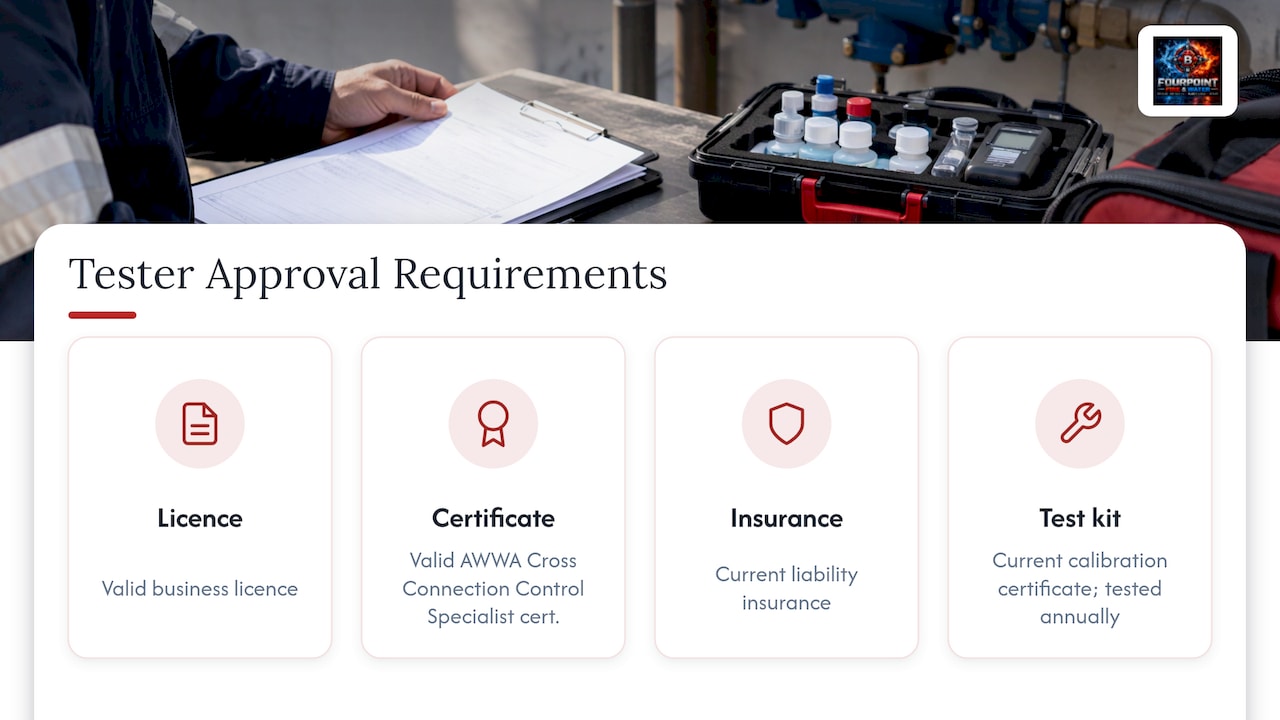
In Alberta, the water utility often sets the tester requirements. In the Grande Prairie area, Aquatera’s cross connection control program lists what a certified tester must provide to be approved: a valid business licence, a valid AWWA Cross Connection Control Specialist certificate, current liability insurance and a current calibration certificate for the test kit, which must be tested annually. Aquatera also states that residential customers are not required to complete annual testing, because most residential fixtures already have built-in backflow protection. The program is aimed at commercial, industrial and institutional connections.
If your property sits in another Alberta, British Columbia, Saskatchewan or Manitoba municipality, confirm the local requirement with your utility before booking a test.
How hard is certification to obtain?
For a tester, certification is a structured course followed by exams, not a formality. The BCWWA’s 75% pass mark on both written and practical parts and the three-device practical show that candidates are expected to demonstrate the procedure on real assemblies. The 2023 edition of the CSA B64.10 and B64.10.1 standards revised device selection and installation guidance and clarified field-testing requirements, including a pressure-drop procedure across check valve 2 for RP devices. Testers need to work to the current edition of the standard, and recertification keeps their knowledge up to date.
For an owner, the useful question is not how hard the exam is but whether the person on your roof or in your mechanical room is recognised by your utility, carries a calibrated kit and files results in the form the authority expects.
Which devices must be tested, and how often
Testing is required for “testable” assemblies, meaning devices with test cocks that allow field testing. Schedules from several Canadian authorities show a common pattern:
| Authority | When testing is required | Source |
|---|---|---|
| Vancouver, BC | At installation, annually, after cleaning, repair or alteration, and when requested by the City Engineer | City of Vancouver |
| Surrey, BC | Annually for testable devices; a single-family irrigation double-check assembly is tested at installation only | Surrey Bylaw 17988 |
| Regional District of Nanaimo, BC | At installation, after repair, and at least every 12 months | RDN bylaw |
| Toronto, ON | At installation, within 72 hours after cleaning, repair, replacement, servicing or overhaul, and at least annually | City of Toronto |
| Waterloo, ON | At installation, annually, after cleaning, repair, overhaul or relocation, or when an officer requests it | City of Waterloo |
| Moncton, NB | At installation and at least annually, with retesting after repair, removal and reinstallation, or relocation | City of Moncton |
The differences matter. Surrey exempts one residential irrigation case from annual testing, while Toronto’s 72-hour window after servicing is much tighter than a typical annual reminder. Toronto also requires owners to update cross-connection surveys at least every five years unless otherwise approved. A cross-connection survey is a review of every point where a potable (drinking) water line could meet a non-potable source, and it determines which assemblies a building needs.
Where hydrants and fire lines fit in
Backflow assemblies are not limited to plumbing rooms. Fire sprinkler systems, standpipes and private hydrant lines are connected to the potable supply, and the connection is commonly protected by a backflow assembly. That is why a property with a private fire line often has one more device on its annual list than the owner expects. Testing the assembly is separate from inspecting the hydrant, sprinkler riser or standpipe, but the two are usually scheduled by the same person, so it helps to plan them together.
For private hydrants, our private hydrant inspection and maintenance work covers the hydrant itself and the related underground piping, while cross-connection control addresses the protection of the water supply. Knowing which of your assemblies sit on a fire line versus a domestic or process line is the first step in building an accurate test list.
What a test looks like and what you must file
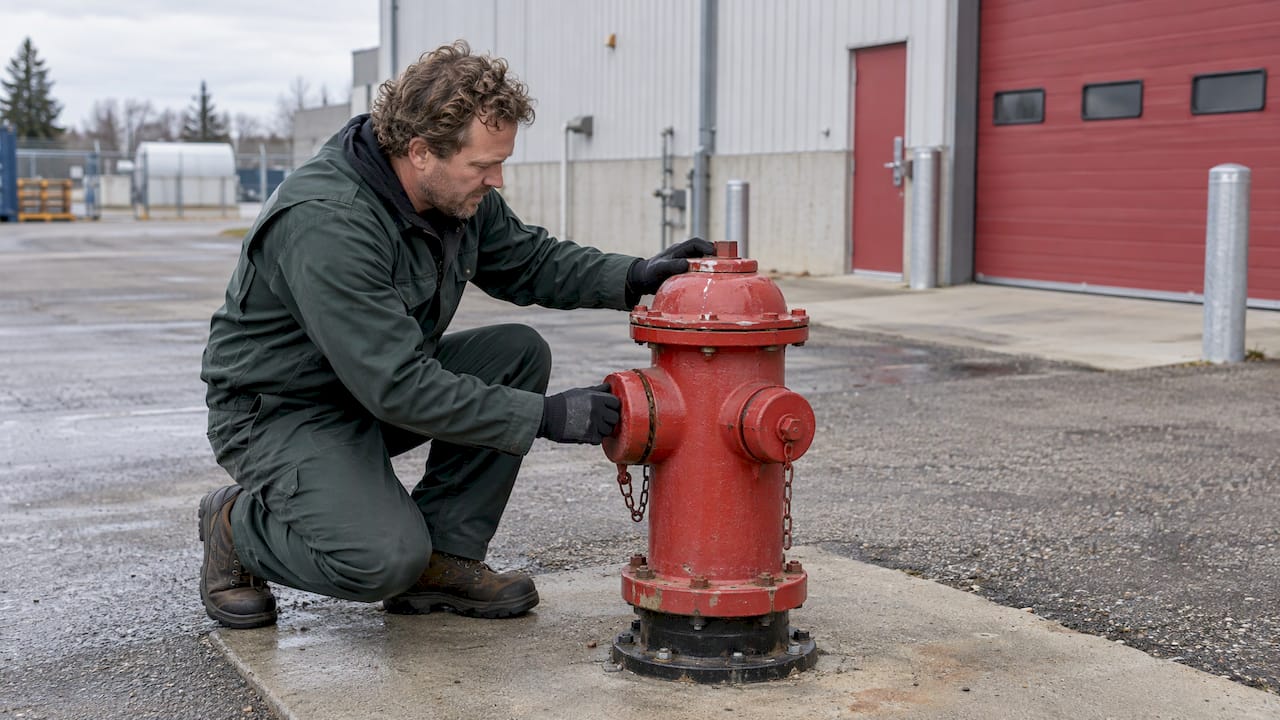
A field test checks that the internal check valves hold pressure and the relief valve (on an RP assembly) opens as designed. In Surrey, a certified tester must field-test devices in accordance with the standard, complete a test report and, if the device passes, sign the report and affix a passed tag.
Reporting deadlines differ:
- Vancouver: results reported to the City within 15 days of each test.
- Toronto: results reported by a Certified Cross Control Specialist through the City’s online test report form.
- Surrey: a report within 14 days of a new installation and after replacement, and within three days after a backflow incident.
- Waterloo: installation reports within 14 days; annual reports available on site when requested; test reports kept on site for at least seven years, and the City test tag must stay affixed.
- Moncton: annual reports showing assemblies have been tested and are functioning properly, with the property owner or water customer ultimately responsible for compliance.
- Regional District of Nanaimo: reports due within 30 days of installation, repair, inspection, test, replacement or relocation.
The pattern is consistent: the tester produces the report, but the owner answers for it. Waterloo’s seven-year on-site retention rule shows that compliance can include durable records, not a single filing.
What happens when a device fails
A failed test is not a violation by itself. It is the trigger for repair and retest within a defined window.
- In Vancouver, failed devices must be repaired or replaced and retested within 15 days of the original test, with separate results submitted after the work.
- In Surrey, if a failed device is not repaired successfully the same day, the tester must immediately notify the consumer and notify the City within three business days.
- In Moncton, maintenance or repair is required immediately after a failed test, followed by immediate retesting.
A practical consequence: schedule annual testing early enough that a failed assembly can be repaired, replaced and retested before your authority’s deadline. Testing in the last week of a compliance period leaves no room for a part to be ordered.
A compliance routine for property managers
- Confirm the authority. Identify your water utility or municipality and ask for its cross connection control or backflow program requirements.
- Build an assembly inventory. List every testable device by location, size, type and service (domestic, irrigation, process, fire line), with serial numbers.
- Check tester credentials. Confirm that the tester’s certificate is the one your authority accepts and that the test kit’s calibration certificate is current.
- Schedule the annual test with enough lead time for repair and retest.
- Confirm the report is filed in the authority’s required format and by its deadline, and keep a copy together with the tag record.
- Retest after any work. Cleaning, repair, replacement or relocation normally triggers a new test.
- Retain records for at least as long as your authority requires; seven years is Waterloo’s on-site standard.
Our perspective
Most compliance problems we see described on commercial properties come down to an incomplete assembly list, not a failed test. A building has a domestic line, an irrigation line and a fire line, and the owner remembers only one of them.
Our work is built around the site. We start with a technical assessment and equipment identification, so scope, context and equipment details are clear before any work is arranged. That is the same discipline that makes a backflow program manageable: know every device, know which authority it reports to, and keep the records in one place.
Our services include inspection, installation, maintenance, design and consulting, and we work on fire hydrants, sprinkler systems, standpipes, backflow prevention, cross-connection control and related underground piping. Because one team can look at the hydrant, the fire line and the assembly that protects it, the owner has one point of contact and one schedule. We also offer 24 hour emergency response for locations within 200 km.
Kevin
Backflow testing with FourPoint
FourPoint Fire & Water provides backflow prevention testing and cross-connection control alongside fire hydrant inspection, maintenance, repair and installation, sprinkler and standpipe service, and underground repairs for commercial, industrial and municipal properties. Kevin Ballantyne, our owner, is a Red Seal Journeyman Sprinkler Fitter who entered the trade in 2001 and earned his journeyman ticket in 2014. Our focus is Grande Prairie, Dawson Creek and the Peace Region. Contact us to confirm availability for your location, and tell us which authority your property reports to so the scope is clear from the start. For the full range of work, see our fire protection guide.
FAQ
Is there one national backflow certification in Canada?
No. Provincial bodies such as BCWWA and OWWA run training and certification programs, and some utilities accept an AWWA Cross Connection Control Specialist certificate. BCWWA notes that its certification participates in national reciprocity through AWWA Canadian sections, but your local authority has the final say on who may test.
How often does a backflow preventer need testing?
At least once a year in most programs listed above, and also at installation and after cleaning, repair, replacement or relocation. A few cases, such as a single-family irrigation double-check assembly in Surrey, are tested only at installation.
Does every building need a backflow preventer?
Not every building needs a testable assembly. Aquatera, for example, says residential customers are not required to complete annual testing because most residential fixtures already have built-in backflow protection. Commercial, industrial and institutional properties, and any property with a fire line, irrigation or process connection, are more likely to be covered. Your utility can confirm the requirement for your connection.
Who is responsible if a device fails or a report is missed?
The owner or water customer. Moncton states that property owners or water customers are ultimately responsible for compliance, and Quebec’s regulator asks owners to keep proof of verification. The tester supplies the report, but the owner needs to see that it is filed on time.
Sources
- Plumbing licences, Government of New Brunswick
- Watch out for contamination, Régie du bâtiment du Québec
- Certification and Training, OWWA
- Backflow Testing Certification, BCWWA
- Protecting water quality, City of Vancouver
- Backflow Prevention Program, City of Toronto
- Backflow Prevention Program, City of Moncton
- Surrey Regulatory Bylaw 17988
- Backflow Prevention Bylaw, City of Waterloo
- Regional District of Nanaimo bylaw 1788
- CSA B64.10:23 and B64.10.1:23 summary
- Cross Connection Control, Aquatera