A standpipe flow test proves that the water supply, underground piping, valves and risers of your standpipe system can still deliver the design flow and pressure at the hydraulically most remote hose connection (the outlet that is hardest for water to reach). For automatic standpipes, NFPA 25 sets this test at every five years. It is a separate test from a hydrostatic test, and passing one does not satisfy the other. We service fire hydrants, sprinkler systems, standpipes, backflow prevention, cross-connection control and related underground piping in Grande Prairie, Dawson Creek and the Peace Region, and the supply side of a flow test, hydrants and underground mains included, is where many failed tests start.
TL;DR
- A flow test measures water delivery at the most remote hose connection. A hydrostatic test only checks that piping holds pressure without leaking.
- Under NFPA 25, automatic standpipes need a full-demand flow test every five years, and a partial flow does not meet the intent.
- Manual and semiautomatic dry standpipes need a five-year hydrostatic test, normally at not less than 200 psi (13.8 bar) for two hours.
- Your authority having jurisdiction (AHJ, the fire department or code official who enforces the code) sets the exact rules, so confirm the edition and method with them before test day.
- Keep the full report with static, residual and flow readings. Inspectors expect it.
Table of Contents
- What a standpipe flow test actually checks
- Which Canadian rules apply
- How a standpipe flow test is run
- What counts as a passing result
- Records the inspector will ask for
- When the test finds a deficiency
- Our approach to standpipe flow testing
- Standpipe service in the Peace Region
- FAQ
- Sources
What a standpipe flow test actually checks
A standpipe is a rigid pipe system, usually in a stairwell or along a building’s perimeter, that lets firefighters connect hose at a floor without running hose from the street. Class I connections are 2½-inch valves for fire department use. Class II connections carry smaller hose for occupant or trained-brigade use, and Class III combines both.
The flow test answers one question: if the system were needed today, would the water arrive at the pressure and volume it was designed for? Per the National Fire Sprinkler Association, a flow test evaluates actual system performance under operating conditions, confirming that the water supply, underground piping, fire pump, risers, valves and standpipe piping perform as designed.
That last point matters for property managers. A standpipe is only as good as what feeds it. A partly closed valve on the supply, a tuberculated or silted underground main, or a municipal supply that has changed since the building was designed can each pull the result down even when every riser inside the building is sound.
Flow test or hydrostatic test
The two are often confused on work orders.
| Flow test | Hydrostatic test | |
|---|---|---|
| What it proves | Water delivery at design flow and residual pressure | Piping holds pressure without leakage or failure |
| Typical system | Automatic standpipes (wet or dry) | Manual and semiautomatic dry standpipes, dry portions of others |
| Interval under NFPA 25 | Every five years | Every five years |
| Evaluates supply capability | Yes | No |
The City of Vancouver’s standpipe testing bulletin draws the same line: automatic wet standpipes require flow tests only, while manual and semiautomatic dry systems, including the fire department connection piping, require the hydrostatic test.
Which Canadian rules apply
Standpipe testing in Canada is not governed by a single national schedule. Provincial fire codes adopt or reference NFPA 25, and each municipality’s fire department enforces it. In Alberta, where our work is focused, we recommend confirming the fire code edition and any local bulletin with your AHJ. Examples from other provinces show the pattern you will see:
- Vancouver, BC. Under the Vancouver Fire By-law, which references NFPA 25, a flow test is required every five years on all automatic standpipe systems, at the hydraulically most remote hose valve outlets while flowing the system demand.
- Ontario. The Ontario Fire Code (O. Reg. 108/18) requires flow and pressure tests at the highest and most remote hose valve or connection, requires them annually in buildings containing a hotel, and requires hydrostatic testing of dry standpipe piping at intervals not exceeding five years.
- Weyburn, Saskatchewan. The town’s standpipe requirements table lists a five-year flow test by an authorized person, plus annual inspection including a main drain test, quarterly hose valve inspections and monthly gauge and hose cabinet checks.
For new or altered systems, design data matters too. The City of London, Ontario, notes that hydraulic calculations must use hydrant flow test data no older than 12 months. That is a useful reminder that hydrant flow testing and standpipe flow testing are linked: the hydrant results describe the supply, and the standpipe test shows whether the building’s piping can use it.
Events that trigger an extra test
The five-year interval is the routine. Ontario’s code and Weyburn’s table both call for flow and pressure testing after a system is modified, extended, or returned to service after more than a year out of use. Treat any major alteration, long shutdown, fire pump replacement or change to the water supply as a reason to ask your AHJ whether an unscheduled test is expected.
How a standpipe flow test is run
The sequence below follows the City of Vancouver bulletin and NFPA 25. Your AHJ may add or change steps, so agree the method with them in advance. NFPA 25 itself says the test method and performance criteria should be discussed with the AHJ ahead of time.
- Establish what you have. Confirm the standpipe type (automatic, semiautomatic or manual; wet or dry), the original approved design, any modifications, the available supply and the test boundaries. Do not assume every standpipe on your portfolio carries identical testing obligations.
- Use qualified personnel. Vancouver requires that hydrostatic and flow testing be performed by qualified people. Arrange this early, because testing is scheduled around the building’s occupants and the water supply.
- Notify the right people. Tell building management, tenants, the monitoring company and the AHJ. Flowing water can trigger a waterflow alarm, which is expected, but it should not surprise anyone or dispatch a response.
- Inspect before you flow. Cycle the hose valves fully, thread-test them with a test coupling, and check fire department connection couplings and swivels. Vancouver’s bulletin also asks testers to check for hose connections that could exceed 175 psi during flow, and to run an air test before introducing water to manual dry systems.
- Plan the water discharge. Water has to go somewhere that can handle it. Vancouver requires discharge within property lines, and a permit for discharge onto city property or for hydrant use. In the Peace Region, check with the municipality or utility before any hydrant is opened.
- Record static pressure. This is pressure with no water flowing, measured at the gauge location.
- Flow at the most remote connection. Connect the flow equipment at the hydraulically most remote outlet of each zone and flow to the required demand. Typical equipment is a pitot gauge or flow meter, calibrated pressure gauges, a smooth-bore nozzle and hose to carry the water away.
- Record residual pressure and flow. Residual pressure is what remains in the system while water is flowing. Note inlet and outlet pressures at any pressure-regulating valves.
- Confirm alarms and check for leaks. The waterflow alarm should activate, and piping, valves and connections should show no leakage.
- Restore the system. Return every valve to its normal position, drain and reset as needed, and confirm the system is back in service.
Where tests go wrong
Most delays come from preparation, not the flow itself. Common causes include a supply valve found closed, seized hose valves that cannot be cycled, no drainage path for the discharge, or a test attempted with only a partial flow. NFSA’s Terin Hopkins cautions that partial-flow testing does not satisfy NFPA 25’s intent for automatic standpipes, which should be tested at full required flow.
What counts as a passing result
NFPA 25 requires the five-year test to verify that the water supply still provides the design pressure at the required flow at the hydraulically most remote hose connection of each zone. Systems are tested to the requirements in effect when they were installed, which is why the original design documents matter.
Under NFPA 14, the standard for standpipe design, system demand is the flow rate and residual pressure needed at that most remote connection. NFSA explains that for Class I standpipes the acceptance test involves a minimum residual of 100 psi through the two most remote 2½-inch hose valves, with flow of up to 1,000 gpm (1,250 gpm in non-sprinklered buildings) and 250 gpm for each additional standpipe. Class II systems in Ontario’s London guide call for a minimum of 6.3 L/s (100 gpm) at the most remote hose connection.
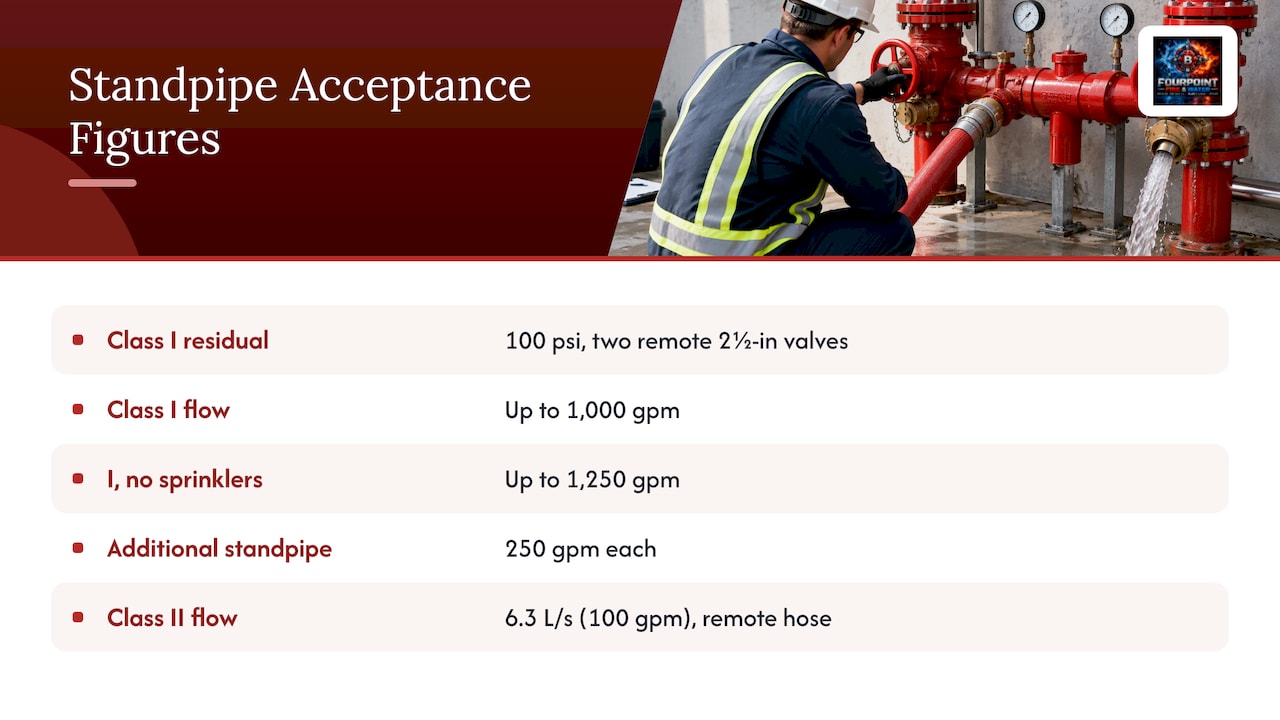
Because the design values depend on installation date, class and building, the number you must hit is the one in your approved design, confirmed with your AHJ. Compare your readings against it, not against a generic figure.
What a worked example looks like
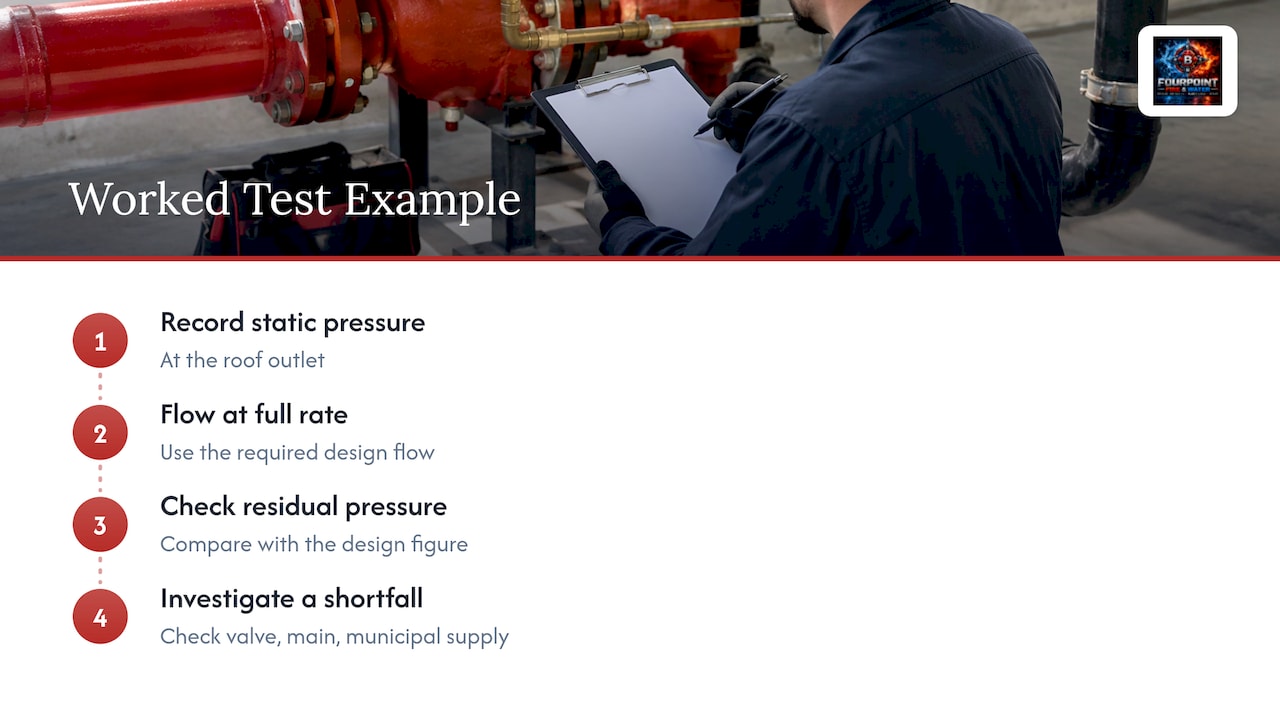
Suppose a four-storey commercial building has an automatic wet standpipe designed for a given demand at the roof outlet. On test day the static pressure is recorded, then water is flowed at the full required rate through the roof outlet. If the residual pressure at that flow falls short of the design figure, the system has not passed, even if every valve cycles cleanly. The usual next questions are whether a supply valve is partly closed, whether the underground main has lost capacity, or whether the municipal supply has changed. These are supply-side problems, and they are why hydrant and underground piping condition belongs in the same conversation. Our note on what hydrant pressure testing measures explains the supply-side readings in more detail.
Records the inspector will ask for
A flow test that is not documented has not happened as far as an inspector is concerned. The report should identify the systems tested, describe the procedure and method, and record complete results: static and residual pressures, flow rates, alarm function and valve positions. Vancouver requires that the completed report go to the building owner or their representative, with a copy kept in the fire safety plan for the fire department to inspect.
A few habits make audits easier:
- Store every five-year report with the original design documents so the next tester knows what the system was designed to deliver.
- Log the date, tester, equipment used and the AHJ’s agreed method.
- Note any deficiency with the date it was found and the date it was corrected.
- Keep dry standpipe hydrostatic reports with flow reports, but never substitute one for the other.
If your team is tightening how test and compliance paperwork is organized, these professional recordkeeping best practices cover habits that carry over to fire protection files.
When the test finds a deficiency
A failed or marginal result is information, and the sequence that follows is practical:
- Confirm the reading by checking gauges and equipment calibration.
- Check the supply path: control valves, backflow assemblies, the fire pump if there is one, and the underground piping.
- Repair what is found, whether that is a valve, a hose connection, a leaking joint or a section of underground main.
- Retest the affected zone and document both the failure and the corrected result.
- Tell the AHJ if the system was impaired, and follow their guidance on interim measures.
Standpipes seldom fail in isolation. A backflow preventer on the supply can restrict flow, a frozen or damaged hydrant can cut the municipal side, and underground piping can lose capacity. A contractor who can work on all of those avoids the hand-offs that stretch out a retest.
Our approach to standpipe flow testing
Property managers often call us when a five-year date is approaching, or after an inspector has asked for a report they cannot find. In both cases the first thing we want is the paper: the standpipe class, the original design demand and the last report. A flow test is only meaningful against a design number.
The second thing we look at is the supply. We work on fire hydrants every day, so we think about the full path water takes from the main to the most remote hose valve, including hydrants, underground piping, backflow assemblies and the standpipe itself. That context lets us explain a marginal result rather than only record it.
Our services include inspection, installation, maintenance, design and consulting, and I lead the work as a Red Seal Journeyman Sprinkler Fitter. I entered the trade in 2001 and earned my journeyman ticket in 2014. We make no promises about results, and we do not arrange work until the scope, the site context and the equipment details are clear to you.
Kevin
Standpipe service in the Peace Region
FourPoint Fire & Water works with commercial property managers, industrial facilities and municipalities on standpipe system inspection and maintenance, and on the hydrants and underground piping that supply them. For hydrants specifically, that includes inspection, maintenance, repair, replacement, installation and excavation. We also handle sprinkler systems, backflow prevention and cross-connection control.
Our service area is Grande Prairie, Dawson Creek and the Peace Region, and we offer 24 hour emergency response for locations within 200 km. Contact us to confirm availability for your location, and bring your last standpipe report and design documents if you have them.
To start a conversation about scope, see our standpipe systems page or reach us through fourpointfire.com.
FAQ
How often does a standpipe need a flow test?
Under NFPA 25, automatic standpipe systems need a full-demand flow test every five years. Some codes add more frequent testing: Ontario requires annual flow and pressure tests in buildings containing a hotel. Confirm the edition and any local schedule with your AHJ.
Is a standpipe flow test the same as a hydrostatic test?
No. A flow test measures delivered flow and residual pressure at the most remote connection. A hydrostatic test, normally at not less than 200 psi (13.8 bar) for two hours on manual and semiautomatic dry standpipes, checks only that piping holds pressure without leakage. Each answers a different question, and one does not replace the other.
What psi should a standpipe flow at?
There is no single number. The target is the design demand for your system, set by its class and installation requirements. For Class I standpipes tested under NFPA 14, NFSA describes a minimum 100 psi residual through the two most remote 2½-inch hose valves. Your approved design and AHJ confirm the figure for your building.
Who is allowed to perform the test?
Qualified personnel. Vancouver’s bulletin requires this for both flow and hydrostatic tests, and Weyburn’s table specifies an authorized person for the five-year flow test. Ask your AHJ what qualifications they accept in your area.
Do we need a permit to discharge the water?
It depends on where the water goes. Vancouver requires discharge within property lines and a permit for discharge onto city property or hydrant use. Check with your municipality or water utility before test day.
Sources
- City of Vancouver, Standpipe system testing bulletin
- NFSA, Understanding the five-year inspection and testing requirements for standpipe systems
- NFSA, Understanding standpipe flow testing
- Ontario Fire Code, O. Reg. 108/18
- City of London, Standpipe Systems guide
- Town of Weyburn, Standpipe and Hose Systems Requirements
- NFPA 25, standpipe testing text