The Alberta Fire Code is the National Fire Code of Canada adapted for Alberta. It governs how existing buildings are used and maintained once they are occupied. For an owner or property manager, that means fire hydrants, sprinklers, standpipes, alarms and extinguishers must be inspected, tested, repaired and documented on a schedule. FourPoint Fire & Water works on private and municipal hydrants, sprinkler systems, standpipes, backflow prevention, cross-connection control and related underground piping in Grande Prairie, Dawson Creek and the Peace Region, so this guide leans toward the equipment we service. We lean hardest on hydrants.
TL;DR
- The edition in force is the National Fire Code – 2023 Alberta Edition, which came into force on May 1, 2024. Alberta lists a second printing with revisions and errata as the current version.
- The fire code covers ongoing maintenance and use of a building. The building code covers original construction.
- Private hydrants, sprinklers and alarms need qualified inspection and testing, and written records must stay available to a Fire Safety Codes Officer.
- Municipal owner guides set the practical intervals. Confirm yours with the local authority.
- Contact us to confirm availability for your location.
Table of Contents
- How the Alberta Fire Code relates to the National Fire Code
- Which edition is in force
- Who the code applies to
- Inspection and maintenance intervals
- Fire hydrants under the fire code
- Sprinklers, standpipes and backflow
- Records, deficiencies and enforcement
- Making compliance routine
- Working with FourPoint
- Our perspective
- FAQ
- Sources
How the Alberta Fire Code relates to the National Fire Code
The National Research Council prepares model codes centrally. Provinces then adopt and enforce them, and Alberta publishes its own fire code based substantially on the national model, with provincial variations. The current Alberta document is the National Fire Code – 2023 Alberta Edition, abbreviated NFC(AE). The NRC states that it is based on the National Fire Code of Canada 2020.
So “the Alberta fire code” and “the National Fire Code Alberta edition” are the same thing. In Alberta, the national code alone does not apply. The Alberta edition does, and some requirements are moved into Divisions A or C to suit Alberta’s regulatory framework.
Which edition is in force
The Government of Alberta’s code history shows that the 2023 Alberta Edition took effect on May 1, 2024. It replaced the 2019 Alberta Edition, which had been in force since December 1, 2019. A second printing of the 2023 edition with revisions and errata was released on August 17, 2026. If you are working from an older printed copy or a 2006 study guide, check it against the current edition.
What changed in the 2023 edition
The NRC’s summary lists the main changes:
- Consolidated fire safety plan requirements.
- Classifications for five widely used water-miscible liquid mixtures.
- Measures for encapsulated mass-timber construction.
- New medical-oxygen storage requirements in residential and health-care occupancies.
- Clarified prohibitions, including sky lanterns and barred or locked exit doors.
- Expanded qualification requirements in Division C.
The full list is on the NRC publication page. If you are updating your fire safety plan, our guide to a fire safety plan for commercial buildings in Alberta covers it in more detail.
Projects already underway were considered in the transition. Alberta’s notice on the new code editions allows specified work with permits or substantially completed plans to stay under the earlier edition, subject to the authority having jurisdiction.
Who the code applies to
The NFC(AE) applies to new and existing buildings and facilities, and to construction, renovation and demolition sites, subject to exceptions stated in Division B Part 4. In practice the duty falls on the owner. That includes commercial landlords, industrial operators and municipalities responsible for public infrastructure.
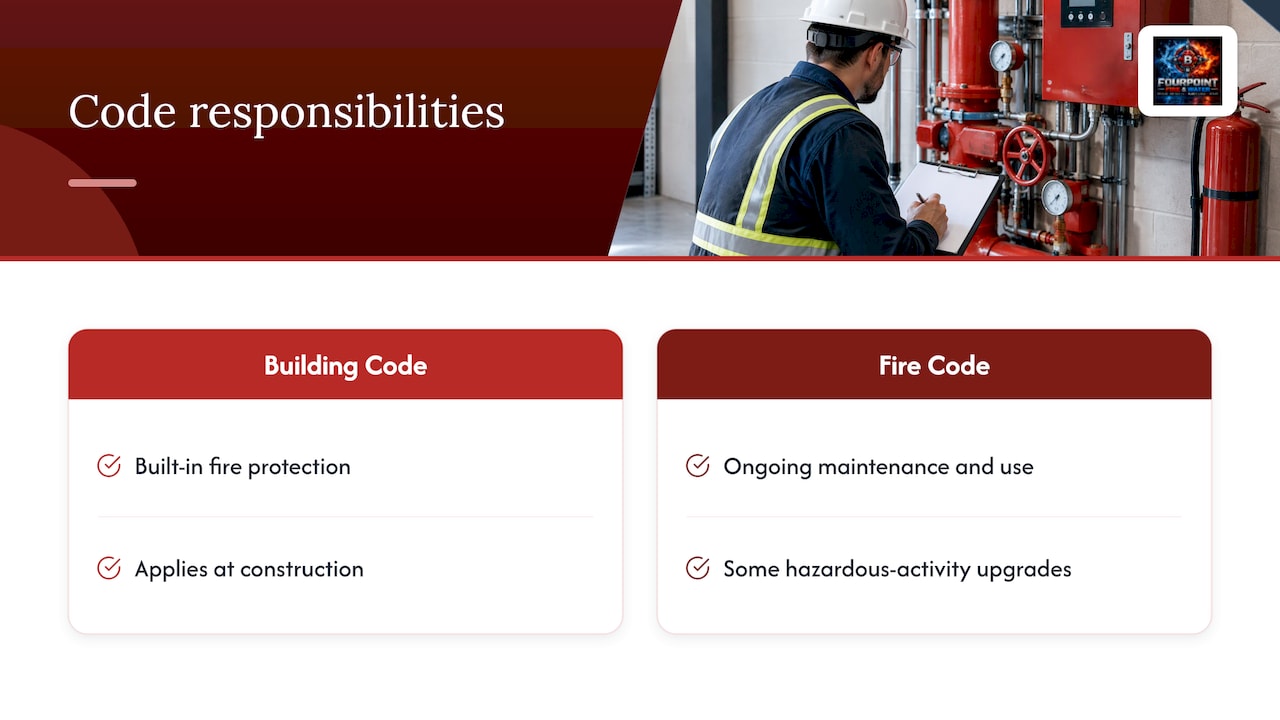
It helps to separate the two codes by stage of a building’s life. The Alberta Building Code covers fire protection features built in at construction. The fire code covers ongoing maintenance and use, and some upgrades when hazardous activities or processes are introduced. The two are complementary, and some fire code provisions are referenced in the building code.
Inspection and maintenance intervals
The code requires systems to be maintained in working order, and the referenced standards and local authorities set the details. Municipal owner guides are the clearest summary available. The table below draws on two of them. It is a starting point, not a substitute for your authority’s current requirements.
| Item | Interval | Source |
|---|---|---|
| Fire alarm indicators, exit signs, fire doors closed | Daily | Okotoks 2025 guide |
| Sprinkler control valves, dry-pipe air pressure, fire pump | Weekly | Okotoks 2025 guide |
| Portable extinguishers, emergency lighting batteries, fire door operation | Monthly, with written records | Okotoks 2025 guide |
| Fire alarm and sprinkler systems | Annual inspection and testing by qualified persons | Calgary owner guide |
| Private fire hydrants | Annual inspection, testing and maintenance | Calgary business licence checklist |
These guides do not set a single interval for every standpipe or fire door, so confirm those with the NFC(AE), the referenced standards and your local authority.
Fire hydrants under the fire code
A private hydrant is one on your property, fed from your own water service line rather than the municipal main. Owners often treat these as the city’s responsibility, but the maintenance duty sits with the property owner. Calgary’s checklist says private hydrants are to be inspected, tested and maintained annually, with records kept at the premises for a Fire Safety Codes Officer to examine.
A hydrant inspection should confirm that the unit is accessible, that the barrel drains properly, that valves operate through their full range, and that caps and outlets are in good order. Winter matters in the Peace Region. A hydrant that does not drain can freeze, and a frozen hydrant fails when it is needed. Our hydrant inspection, hydrant maintenance and private hydrant service pages describe what we do on site. We also handle hydrant troubleshooting, repair, replacement, installation, excavation and underground hydrant repairs, including winter-related failures.
Municipalities have the same obligation across a larger network. We support municipal hydrant maintenance programs for towns and counties in Alberta.
Sprinklers, standpipes and backflow
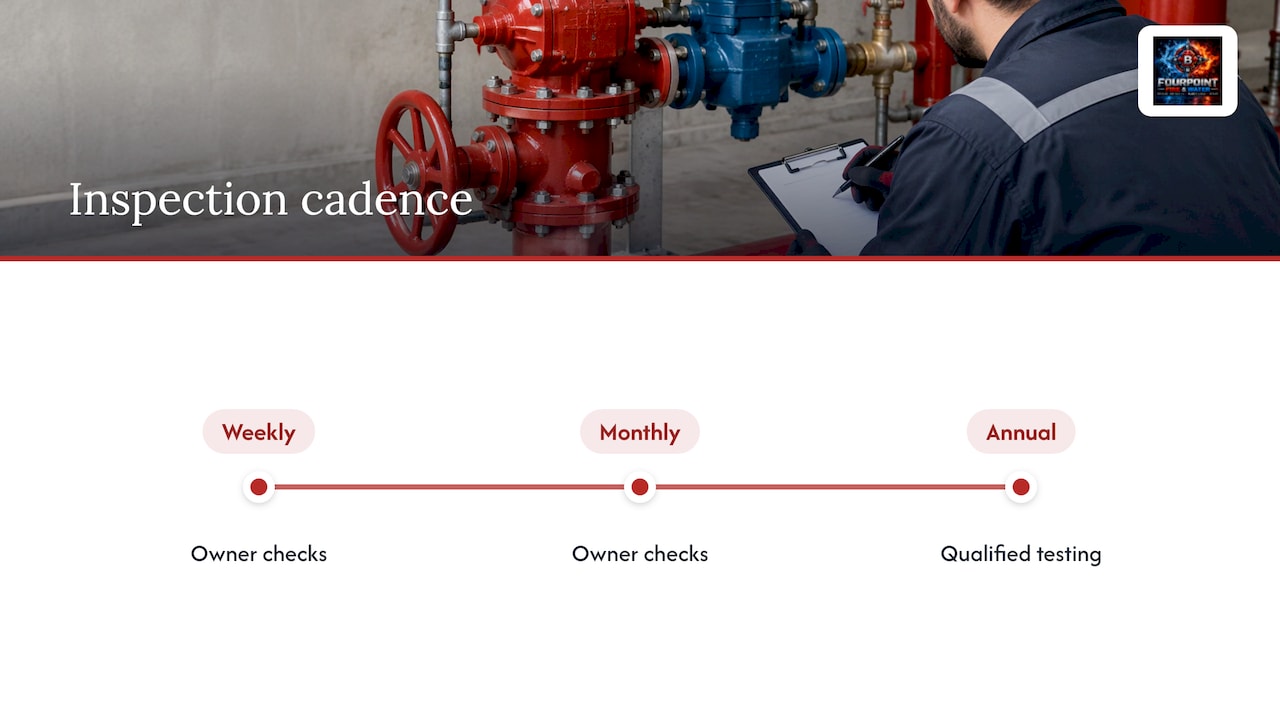
Sprinkler systems receive annual inspection and testing by qualified persons, with weekly and monthly owner checks in between. Our sprinkler inspections, sprinkler repairs and standpipe systems pages cover this work. Corrosion is a common finding in older systems, and we explain the warning signs in our article on sprinkler pipe corrosion and freeze risks.
Backflow prevention matters because a fire line connected to the potable water supply is a cross-connection. A backflow assembly is a device that stops water from flowing backward into the drinking supply. It has to be tested with calibrated equipment by a certified tester. See backflow prevention testing, cross-connection control and our explanation of who can test backflow assemblies in Canada.
Records, deficiencies and enforcement
Inspection is only half of compliance. The other half is proof.
- Okotoks states that inspection reports must be kept on site for two years and be available to a Fire Safety Codes Officer.
- Under the Safety Codes Act, an officer may inspect premises at reasonable times without a warrant and demand compliance records. Occupied private dwellings require consent or a warrant.
- Owners who fail to meet listed maintenance requirements may face fines or imprisonment under the Safety Codes Act.
When a deficiency is found, local reporting rules can add deadlines. Edmonton’s Fire Marshal Bulletin, revised in October 2026, sets out reporting after 14 days for unresolved deficiencies, and within 24 hours for defects affecting system operation or coverage. It also notes that tabular reporting under CAN/ULC-S536-19 became mandatory when the NFC(AE) took effect. Emergency repairs or a fire watch may be required. Other municipalities set their own rules, so ask your local fire department.
Making compliance routine
A workable annual routine for a commercial property:
- List every system on site: hydrants, sprinklers, standpipes, backflow assemblies, alarms and extinguishers.
- Assign the daily, weekly and monthly owner checks to named staff and log them.
- Book the annual inspection and testing with a qualified contractor before the cold season, so hydrant repairs are not left to winter.
- File each report and keep it on site where an officer can examine it.
- Repair deficiencies promptly and keep the repair record with the original report.
A contractor who knows the equipment on your site makes steps 3 to 5 faster. Our process starts with a site-specific assessment, identifying the equipment and its operating context before any work is arranged.
Working with FourPoint
FourPoint’s services include inspection, installation, maintenance, design and consulting for hydrants, sprinkler systems, standpipes, backflow prevention, cross-connection control and related underground piping. We offer 24 hour emergency response for locations within 200 km. Our hydrant services page lists the full range, and our service area guides describe the Peace Region. Contact us to confirm availability for your location.
Our perspective
Most compliance problems we are called to look at are not about a missing system. They are about equipment nobody has identified, tested or documented, and hydrants are the usual example. A private hydrant sits outside for years, and the first time anyone checks it is when an officer asks for the record.
The code gives owners a clear duty: keep fire protection equipment in working order and be able to show it. We think the best way to meet it is a site-specific assessment first, so the scope, the equipment and the operating context are understood before work is arranged. That is how we work, led by Red Seal Journeyman Sprinkler Fitter Kevin Ballantyne, who entered the trade in 2001 and earned his journeyman ticket in 2014.
A regular inspection and maintenance routine, with records filed where they can be found, is what supports compliance. We cannot promise any inspection outcome, but we can make sure you know the condition of your equipment.
Kevin
FAQ
Which Alberta fire code edition applies now?
The National Fire Code – 2023 Alberta Edition, in force since May 1, 2024. Alberta also lists a second printing with revisions and errata. Check Alberta.ca for the current printing.
Is the Alberta Fire Code different from the National Fire Code of Canada?
Yes. Alberta adopts the national model and modifies it for provincial needs. The Alberta edition is the legal document for buildings in the province.
Who is responsible for hydrant maintenance on private property?
The property owner. Calgary’s checklist calls for annual inspection, testing and maintenance of private hydrants, with records kept at the premises. Contact us to arrange it in the Peace Region.
How long should inspection records be kept?
Okotoks requires reports to be kept on site for two years. Your authority may differ, so confirm locally.
Sources
- Fire codes and standards, Alberta.ca
- National Fire Code: 2023 Alberta Edition, NRC
- National Fire Code 2023 Alberta Edition, full text, NRC
- Model code adoption across Canada, NRC
- Second printing notice, Government of Alberta
- Notice: New Alberta codes editions
- Fire Safety Information for Business Owners, City of Okotoks
- Fire Safety Maintenance Requirements, City of Calgary
- Business Licence Pre-inspection Checklist, City of Calgary
- Fire Marshal Bulletin 26-001, City of Edmonton
- Safety Codes Act, CanLII