A backflow preventer inspection is a formal check, by a qualified tester using calibrated gauges, that the device protecting your drinking water supply still holds pressure as designed. For commercial and industrial properties in Canada, it is normally done at installation and then at least once a year, with a written report sent to the water utility. In the Peace Region, we carry out backflow prevention testing alongside our hydrant, sprinkler and standpipe work, so the fire line and the potable water connection are looked at by the same team. Please contact us to confirm availability for your location.
TL;DR
- A backflow preventer inspection confirms that internal seals, springs and check valves are working, and that the device has not been bypassed. A look from the outside cannot confirm this for mechanical devices.
- Canadian municipalities that publish their rules typically require testing at installation, then annually, and again after any repair or overhaul. Your local water utility sets the schedule that applies to you.
- The tester must be certified, use calibrated equipment, and file the report with the utility. Many bylaws also require you to keep copies on site for years.
- A failed device usually has to be repaired or replaced within days, and some utilities can shut off water service if it is not.
- Fire lines, hydrant connections and standpipes are common places for backflow devices, so they are worth scheduling together with your fire protection inspections.
Table of Contents
- What a backflow preventer does and why it is inspected
- Types of device you are likely to see
- What happens during an inspection
- How often commercial properties need testing
- Who is qualified to test
- Records, tags and reports
- What happens when a device fails
- Fire lines, hydrants and why they belong together
- An annual checklist for property managers
- Our approach to backflow and fire line testing
- Booking a test in the Peace Region
- FAQ
- Sources
What a backflow preventer does and why it is inspected
Backflow is water flowing the wrong way in a piping system. It happens when pressure drops on the supply side, for example during a main break or heavy hydrant use, or when pressure builds up downstream. If a connection exists between drinking water and something that is not drinking water, such as a boiler, a fire sprinkler loop, an irrigation line or process equipment, contaminated water can be drawn back into the supply. That connection is called a cross-connection, and a backflow preventer is the device that guards it.
Mechanical devices wear. The American Backflow Prevention Association explains that seals, springs and moving parts are subject to fouling, wear or fatigue, which is why mechanical assemblies need periodic testing with properly calibrated gauge equipment, while an air gap only needs a visual check. A device can look fine from the outside and still leak backward through a tired check valve.
Types of device you are likely to see
The Canadian Food Inspection Agency lists six basic types of backflow prevention device: air gaps and barometric loops (non-mechanical), and atmospheric vacuum breakers, pressure vacuum breakers, double check valves with an intermediate atmospheric vent, double check valves and reduced pressure devices (mechanical). In commercial buildings you will mostly meet three:
| Device | What it is | Typical use |
|---|---|---|
| Air gap | A physical open space between the potable outlet and the receiving system | Sinks, tanks, equipment fill points |
| Double check valve assembly (DCVA) | Two spring-loaded check valves, two shut-off valves and four test cocks | Moderate-hazard connections, often fire sprinkler supply lines |
| Reduced pressure principle assembly (RPZ) | Two check valves with a relief valve between them that vents if pressure fails | Severe-hazard connections |
Toronto’s bylaw illustrates how the choice follows risk: a DCVA for moderate-hazard facilities and a reduced pressure assembly for severe-hazard facilities. A test cock is simply a small valve port where the tester connects a gauge.
What happens during an inspection
The level of inspection depends on the device. For non-mechanical devices, the CFIA describes a visual inspection to confirm they are in place and unaltered. For mechanical devices it calls for a visual inspection of internal seats, springs and moving parts, a check that the device has not been bypassed, and functional testing.
In practice, a field test for a mechanical assembly follows this sequence:
- Notify the building. Testing means isolating the device and interrupting flow, so occupants, tenants and any process that depends on that line need notice first.
- Isolate the device and attach the gauge. The tester connects a differential pressure gauge to the test cocks.
- Open and close valves in sequence. Each zone is pressurized in turn and the pressure differences are recorded against the values the device is designed to hold.
- Inspect internals. Seals, springs, check valves and the relief valve are examined for wear. Roto-Rooter’s published description of the test follows the same pattern.
- Repair or clean if needed, then retest. A device that fails is normally serviced and retested before it is returned to service.
- Tag the device and file the report. The result goes on the test tag and to the utility.
The common failure point for property managers is step 1. A line that cannot be shut down is a line that cannot be tested. Northumberland County’s by-law addresses this directly: where the supply cannot be shut off, a bypass with its own backflow device must be installed so that both devices can be tested. Raising this at the planning stage avoids a missed test date.
How often commercial properties need testing
Backflow rules in Canada are set by provinces through plumbing codes and then enforced by municipal water utilities, so the exact schedule depends on where the property sits. The CFIA itself notes that its guidance does not replace provincial or municipal plumbing codes. The published bylaws share a pattern:
- Toronto: testing at installation, within 72 hours after cleaning, repair, replacement or overhaul, and at least annually, with copies of records kept on site for at least seven years.
- Kelowna, BC: inspection and testing by a Backflow Prevention Assembly Tester at installation and annually, with a City-prescribed tag showing the last inspection date.
- Orillia, ON: devices retested within 13 months of the previous test, plus a cross-connection inspection report with a piping drawing at longer intervals.
- Carleton Place, ON: test reports submitted within 14 days.
The common thread is annual testing, retesting after any work on the device, and a short filing window. For a property in Alberta or northeastern BC, ask your water utility or municipality for its cross-connection control requirements and your hazard classification, then build the annual test into your maintenance calendar. If you are unsure which authority applies to your site, our team can help you work through it.
Who is qualified to test
A backflow test is not general plumbing work. The CFIA recommends that a qualified person perform the test and notes that provincial water associations or municipalities keep lists of certified testers. Municipal requirements are specific. The City of Waterloo, for example, requires testers to hold a current tester’s certificate, a certificate of qualification in an authorized trade, calibration certification for test equipment and proof of public liability insurance. Carleton Place asks for a calibration certificate issued within the previous 12 months and commercial general liability insurance of at least $2 million.
Before booking, ask any tester for their certification number, the calibration date of their gauge and their insurance certificate. Our own guide to who can test backflow devices in Canada covers the certification side in more detail.
Records, tags and reports
An inspection that is not documented does not count with the utility. Plan for three items each year:
- The test report, submitted to the utility within its deadline. Deadlines in the published bylaws range from 72 hours in Northumberland County to 14 days in several Ontario municipalities and 30 days from request in Kelowna.
- The device tag. Toronto requires each device to show the company name, manufacturer, serial number, size, test date and the tester’s name and certification number.
- An on-site file. Toronto and Waterloo both require records to be retained for at least seven years.
Some programs also track the property’s hazard level. Toronto requires the City to be told of any change to a property’s hazard level, which matters after a renovation, a change of tenant or the addition of process equipment.
What happens when a device fails
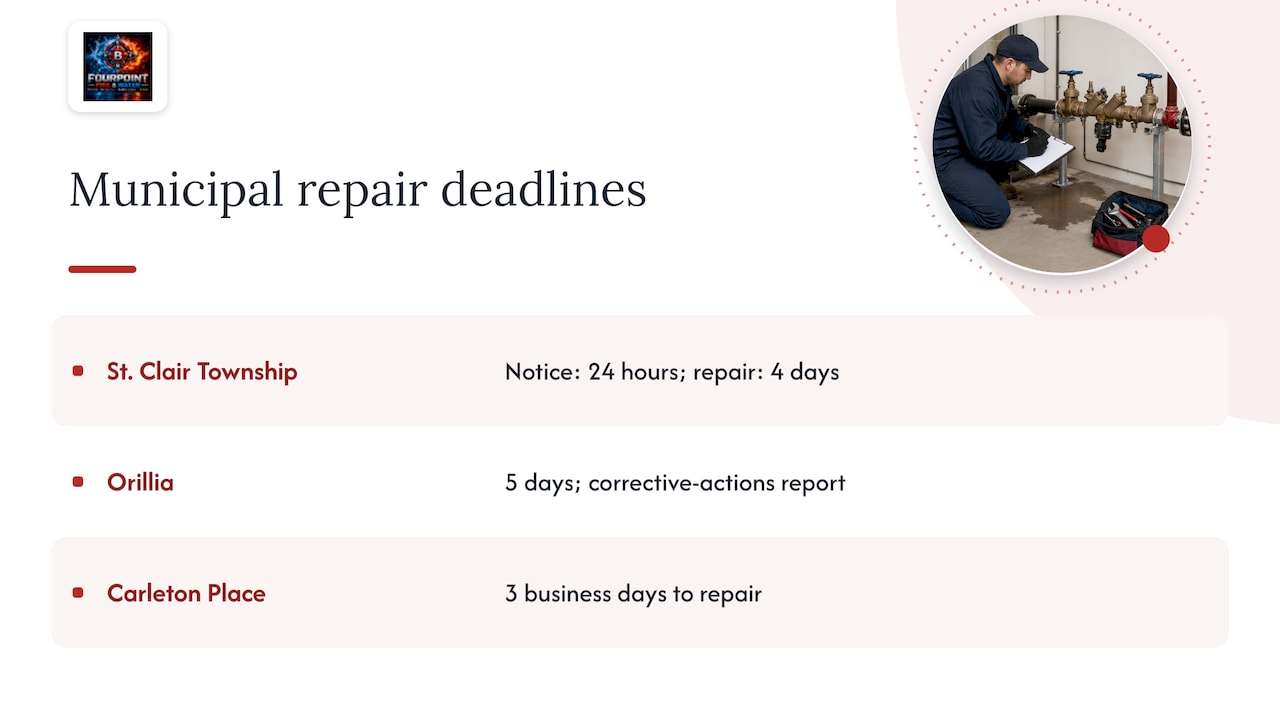
A failed test is a repair order with a deadline, not a penalty by itself. Under St. Clair Township’s by-law, the tester takes the failed device out of service and retests it immediately after cleaning, repair or replacement. The owner provides written confirmation of the failure within 24 hours and has four days to repair or replace the device. Orillia allows five days and requires a corrective-actions report, and Carleton Place allows three business days for a device that could not be repaired during the test.
In each case the utility may shut off water service if the device is not repaired and approved in time. That is the practical reason to schedule the annual test well ahead of the utility’s deadline, so that parts, excavation or a replacement can be arranged without a service interruption. If a device is leaking or discharging water, our note on backflow preventer leaks: causes and first steps explains what to check.
Fire lines, hydrants and why they belong together
Fire protection piping is one of the most common places for a backflow device, because the water in a sprinkler or fire service line can sit stagnant and pick up contaminants that must not return to the drinking supply. The device sits on the same underground service that feeds sprinklers, standpipes and private hydrants, and it is often the first component to be tested or serviced when that service is worked on.
This is why we treat these systems together. Our services include inspection, installation, maintenance, design and consulting, and we work on fire hydrants, sprinkler systems, standpipes, backflow prevention, cross-connection control and related underground piping. For a property with private hydrants, scheduling the backflow test and the private hydrant inspection and maintenance in the same visit window cuts the number of times the line is shut down. Our overview of fire backflow testing for property managers walks through how this fits a facility’s annual routine, and hydrant pressure testing explains what flow and pressure readings tell you about the supply feeding your fire protection.
Winter matters in the Peace Region. Frozen hydrants and winter-related failures are part of our hydrant service, and an exposed or poorly heated device enclosure is a risk to both the hydrant and any backflow assembly on the same line.
An annual checklist for property managers
- Confirm with your water utility which devices on the property are registered and what hazard class each carries.
- Keep a list of every device: location, type, size, serial number and last test date.
- Book the test before the utility’s due date, leaving room for a repair and retest.
- Give tenants and operations staff notice of the shutdown.
- Confirm the tester’s certification, gauge calibration and insurance.
- File the report within the deadline and store the copy and the tag details on site.
- Re-test after any repair, relocation or overhaul, and update the utility if the building’s use changes.
Our approach to backflow and fire line testing
FourPoint’s services are led by Kevin Ballantyne, a Red Seal Journeyman Sprinkler Fitter. He entered the trade in 2001 and earned his journeyman ticket in 2014. Our process emphasizes site-specific assessment and clear communication, so scope, context and equipment details are settled before any work is arranged.
We see backflow testing as part of the whole water side of fire protection, not a separate chore. The device, the underground piping it protects and the hydrants and sprinklers downstream all share the same service line, and the cleanest way to keep that line compliant is to look at it as one system.
Our focus is hydrants, so we pay attention to what a hydrant, a standpipe or a sprinkler riser is connected to, and to where a device sits relative to it. A site-specific assessment up front lets us identify the equipment, understand how the property operates and agree the scope with you before work begins. That is how we keep tests, repairs and records lined up with your utility’s requirements.
If a device needs repair or replacement, or the line needs excavation, we can arrange that as part of the same engagement.
Kevin
Booking a test in the Peace Region
FourPoint provides fire hydrant inspection, maintenance and repair, sprinkler, standpipe and backflow system service, and cross-connection control for commercial, industrial and municipal properties in Grande Prairie, Dawson Creek and the wider Peace Region. We offer 24 hour emergency response for locations within 200 km. Details of the testing service are on our backflow prevention testing page, and our cross-connection control page covers the program side. Please contact us to confirm availability for your location.
If your hydrants are on the same schedule, our hydrant services page lists inspection, preventative maintenance, repair, replacement, installation and underground hydrant repairs.
FAQ
What is a backflow test?
It is a formal inspection of the backflow prevention device that checks its valves and seals hold pressure as designed. A certified tester attaches calibrated gauges to the test cocks and records the pressure readings. The result is documented on a report and a tag.
How often does a commercial backflow preventer need inspecting?
Municipalities that publish their rules, including Toronto and Kelowna, require testing at installation and at least annually, plus after any repair or overhaul. Your own utility sets the schedule for your site, so confirm it with them and book ahead of the due date.
What happens if a device fails the test?
The device is serviced or replaced and retested. Published bylaws give owners a few days to complete this, for example four days in St. Clair Township and five in Orillia, and the utility may shut off water service if the work is not done in time.
Do air gaps need testing?
An air gap is a physical open space, so it needs a visual check that it is in place and unaltered. Mechanical devices such as double check valves and reduced pressure assemblies need a functional test with calibrated gauges.
Sources
- Preventing water backflow, Canadian Food Inspection Agency
- Frequently Asked Questions, American Backflow Prevention Association
- Backflow Preventer Types, NFPA
- Backflow Prevention Program, City of Toronto
- Water Regulation Bylaw No. 10480, City of Kelowna
- Cross-Connection Control Program, City of Orillia
- By-law 68-2024, Town of Carleton Place
- Backflow Prevention Bylaw, City of Waterloo
- By-law 38-2023, Northumberland County
- By-law 35-2023, St. Clair Township