A dry pipe sprinkler system needs more attention than a wet one because its piping holds compressed air instead of water, and that air, the valve and the low points are where problems start. Maintenance comes down to a routine: confirm air pressure and valve position every week, keep the valve room above freezing, drain condensation, trip test the valve every year, and inspect the inside of the pipe on a longer cycle. This article sets out that routine for property managers, industrial operators and municipal facility teams in the Peace Region and across Canada. It also covers where it most often goes wrong, and which parts need a certified sprinkler fitter on site.
TL;DR
- Dry pipe systems hold air in the pipe and water behind a dry pipe valve, so air pressure, valve condition and drainage are the core maintenance items.
- Typical Canadian code intervals: weekly gauge checks, monthly alarm tests, annual valve trip tests, a full-flow trip test every three years and an obstruction inspection every 15 years.
- Water left in the pipe causes corrosion and freeze damage, so low-point drains and valve room temperature matter most before winter.
- Keep dated records of every check, test and repair, and notify the fire department and alarm monitoring company before any test.
- We service dry pipe systems, hydrants, standpipes and backflow assemblies in Grande Prairie, Dawson Creek and the Peace Region. Contact us to confirm availability for your location.
Table of Contents
- How a dry pipe system differs from a wet one
- Which rules apply
- The dry pipe maintenance schedule
- Air supply and compressor readiness
- Drains, cold weather and the valve room
- Trip testing, step by step
- The five-year and 15-year inspections
- Records to keep
- Flexible sprinkler drops in dry systems
- Hydrants and underground piping in the same winter plan
- When to call a sprinkler fitter
- Our approach to dry system service
- Perspective
- FAQ
- Sources
How a dry pipe system differs from a wet one
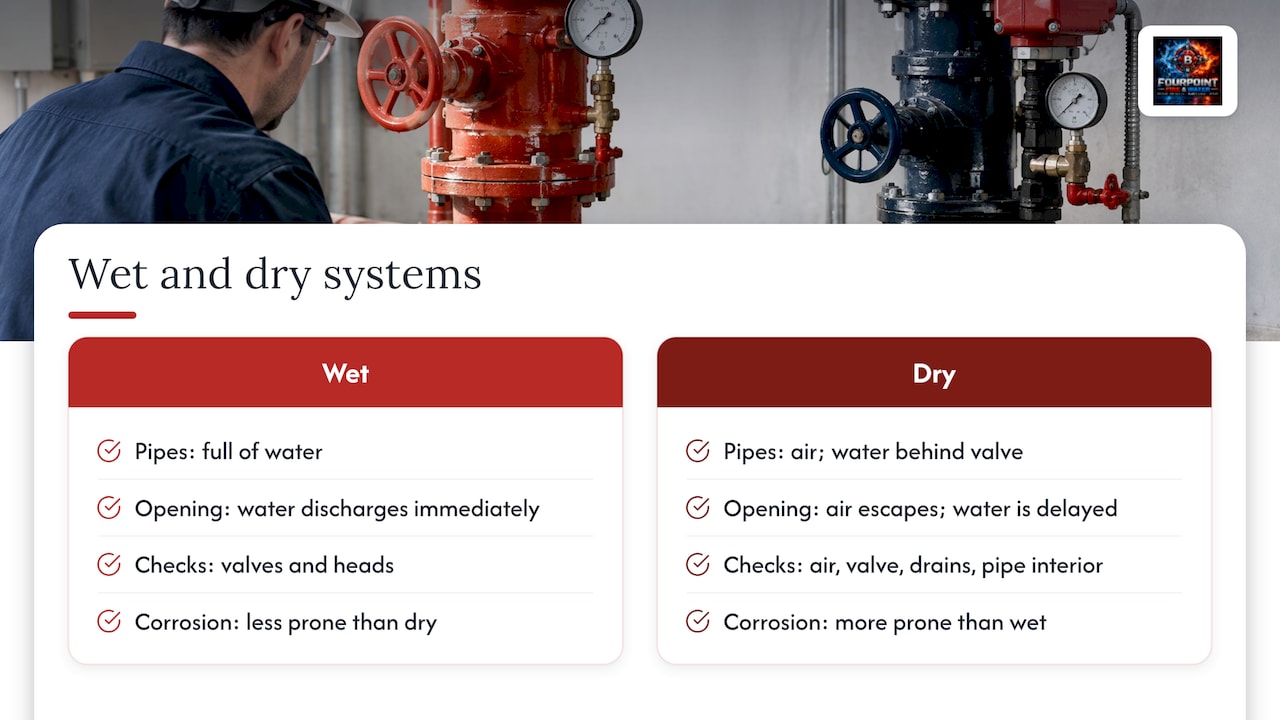
In a wet system the pipes are full of water and a fused sprinkler discharges immediately. In a dry pipe system, the pipe is filled with air and water is held behind a dry pipe valve. When a sprinkler opens, air escapes, pressure drops, the valve trips and water fills the pipe. Because of that delay, system size is limited, and the valve area has to stay warm enough to prevent freezing.
Dry systems suit unheated spaces: parking structures, loading docks, warehouses, arenas and exterior canopies. NFPA’s technical staff describe them as the right choice where temperature cannot be guaranteed above 4°C, which describes much of northern Alberta and the British Columbia Peace from October to April.
For maintenance, the difference is this: a wet system mostly needs its valves and heads checked, while a dry system also needs its air supply, valve internals, drains and pipe interior looked after. Compressed air carries oxygen and moisture, and the combination of water and oxygen is what drives most corrosion in dry systems, according to FM Global’s corrosion data sheet. A 2022 European paper on the subject reports that long-term surveys found dry systems significantly more prone to corrosion than wet ones, which is why one German insurer-backed scheme first inspects dry systems at 12½ years rather than 25.
Which rules apply
In Canada, fire codes are provincial, and each adopts NFPA 25, the standard for inspection, testing and maintenance of water-based fire protection systems. Ontario publishes the most accessible text, and Ontario Regulation 87/25 references NFPA 25-2017 for this work. The intervals below come from Ontario Fire Code Section 6.5 and are a sound reference elsewhere. Your own obligations in Alberta or British Columbia depend on the code edition your authority having jurisdiction enforces and on any conditions on your occupancy or insurance, so confirm them with your local fire authority or with us.
One point matters in practice: under Ontario’s code, following NFPA 25’s inspection, testing and maintenance provisions is deemed to satisfy the code’s maintenance subsections. Repairs and component replacements must follow NFPA 13, the installation standard.
The dry pipe maintenance schedule
The table summarises the Ontario Fire Code Section 6.5 intervals that apply to dry pipe systems. Some items apply only where the system is electrically supervised, meaning it reports valve and flow signals to a monitoring panel.
| Interval | Task |
|---|---|
| Weekly | Read water supply and system air pressure gauges; inspect sealed control valves |
| Monthly | Test the alarm at the test connection; inspect locked or electrically supervised valves |
| Every 2 months | Test transmitters and water-flow devices on electrically supervised systems |
| Every 3 months | Check the priming water level in the dry pipe valve |
| Every 6 months | Test valve supervisory switches and temperature devices |
| Annually | Trip test the dry pipe valve; check heads and hangers; test water supply pressure at the main drain |
| Every 3 years | Full-flow trip test with the control valve fully open |
| Every 15 years | Inspect for obstructions and flush if necessary |
A few items deserve explanation.
Weekly gauge readings. The code requires water supply pressure and system air pressure to be checked weekly by gauge so the system stays at its operating pressure. FM Global’s inspection data sheet recommends holding air pressure at about 20 psi (140 kPa) above the valve’s trip pressure, and never above the system water pressure. A gauge that creeps down day after day points to a leak in the pipe or at a fitting. A compressor that runs constantly points to the same thing.
Priming water. A small amount of water sits in the valve body to seal the clapper. Every three months, check the level. Too little and the seal can leak air; too much can interfere with operation.
Alarm and supervisory tests. Municipal records such as Georgina’s 2025 sprinkler maintenance record show the same pattern: monthly alarm tests, two-month device tests, six-month switch and temperature tests. They also require notifying the fire department, occupants and alarm monitoring company before testing or repairs.
Air leakage testing. NFPA 25 also calls for testing dry systems for air or gas leakage every three years. A training provider’s summary of the standard describes pressurizing to 40 psi for two hours with no more than a 3 psi loss. Where nitrogen is used instead of air, that source says its concentration should be verified semiannually at 98 percent or higher.
Air supply and compressor readiness
The compressor is what keeps the system armed. Since 2017, NFPA 25 has required the air supply to restore normal system pressure within 30 minutes, and on older installations that can mean replacing a compressor that was sized for a different rule. Watch for how often it cycles, how long it takes to recover after a test, and whether an air dryer is fitted and working.
Facilities with sensitive equipment, such as server rooms, depend on this readiness as much as on the choice of suppression, and fire suppression decisions for data centres show how much weight operators put on a supply that performs when called on.
Nitrogen is the main long-term answer to internal corrosion. FM Global’s data sheet recommends nitrogen fills, air dryers and keeping piping dry year-round, and it advises against alternating a system between wet and dry operation. Whether nitrogen suits your system is a design question we can assess on site, as part of our design and consulting work.
Drains, cold weather and the valve room
Water that should not be in a dry system is the most common cause of avoidable damage. Condensation collects at low points, and in winter it freezes and can crack pipe or block flow.
The National Fire Sprinkler Association’s guidance on cold weather says:
- The wet parts of the dry pipe valve must be kept at a minimum of 4°C.
- The valve enclosure should be checked daily in cold weather, or weekly where a low-temperature alarm is fitted.
- Low-point and auxiliary drains should be drained after every system operation, before freezing weather, and as needed afterward, anywhere from daily to monthly depending on how much condensation collects.
- A quick-opening device (an accelerator fitted to speed up valve operation) should be taken out of service temporarily before low points are drained.
FM Global adds a design angle. Dry systems without nitrogen should use galvanized or polymer-enhanced steel pipe, be pitched to drain, keep low-point drains clean and avoid rolled groove joints, which tend to hold water. Our own guide to sprinkler pipe corrosion, warning signs and freeze risks covers what to look for on a walk-through.
Trip testing, step by step
A trip test deliberately opens the dry pipe valve to confirm it releases and water arrives. It carries real risk, because water enters a pipe that is supposed to stay dry. Do it only when there is no danger of freezing, which in the Peace Region means a planned summer or shoulder-season visit. Based on FM Global’s inspection, testing and maintenance data sheet, the sequence is:
- Notify and put monitoring on test. Tell the alarm company, the fire department and occupants so no apparatus is dispatched.
- Verify the control valves are open and do a flow test from the 2-inch main drain first.
- Release air through the system test valve until the dry pipe valve trips.
- Limit water entry. To keep water out of the piping, throttle the control valve to about 5 psi under the dry pipe valve, then close it immediately when the valve trips and open the drain.
- Drain thoroughly, including every low-point drain.
- Open and clean the valve. Remove the cover, wash the interior, wipe the clapper and seat dry and replace deformed rubber parts.
- Reset. Confirm the clapper is latched, refill the priming water and bring the system back to its air pressure.
- Return to service. Take monitoring off test, reopen the control valve fully and record the result.
Two cautions. First, FM Global notes that throttled water supplies will not fully operate some valve models that need a high flow rate to move all their internal parts. That is one reason the three-year full-flow test exists. Second, the same data sheet recommends the valve trip and water reach the remote test connection in 60 seconds or less. HIROC’s 2026 construction guide gives the same 60-second figure for one remote sprinkler, or 40 seconds with the four most remote operating. A slow result calls for investigation: air pressure set too high, a clogged orifice or internal corrosion.
Valve internals are easy to neglect on modern equipment. Older dry valves had to be opened to be reset, which made internal inspection routine. Many newer valves reset externally, so the inside may go unseen for years, and training material notes that severe microbiologically influenced corrosion can cause false trips or slow trip times. Our sprinkler inspection service includes looking at what the gauges cannot show.
The five-year and 15-year inspections
The longer cycles are where owners most often lose track. The Ontario code calls for an inspection for obstructions, with flushing if needed, every 15 years on dry pipe systems, as the City of Windsor’s guide for building owners also lists. NFPA 25 additionally sets a periodic internal assessment of piping and of valve strainers, filters and orifices, commonly described as the five-year inspection. The exact scope depends on the edition your jurisdiction has adopted, so confirm it before scheduling. If an internal look finds foreign material in the pipe, the next step is an obstruction investigation, which is a job for a qualified sprinkler fitter.
Records to keep
Inspectors and insurers look for continuity, so keep a dated log for each system:
- Weekly and monthly gauge readings, with air pressure and water supply pressure.
- Trip test results: trip time, air pressure at trip, time to water at the remote test connection.
- Drain dates and what came out of them.
- Compressor recovery time and any service.
- Repairs, replaced parts and who did the work.
- Notifications made before testing.
A sudden change in any of these is more informative than any single reading.
Flexible sprinkler drops in dry systems
Flexible hose drops can be used on dry systems, but only as a listed assembly. A federal flexible sprinkler hose guide notes that listed dry pendent and sidewall sprinklers with dry flexible hose can serve dry pipe systems, but the hose components are listed together, so intermixing parts from different manufacturers is not permitted. When replacing a damaged drop, match the full listed assembly, and have it installed to NFPA 13.
Hydrants and underground piping in the same winter plan
A dry system’s water supply is only as dependable as what feeds it. Private hydrants, underground mains and the yard piping connecting them to the building can freeze, leak or be buried in snow in the same cold snap that tests the valve room. Many Peace Region sites have private hydrants on the same property as a dry system, and it makes sense to plan the two together: hydrant inspection, preventative maintenance and hydrant troubleshooting before freeze-up, and a response plan for frozen hydrants and winter-related failures. Our guide to how often fire hydrants should be inspected and the Peace Region hydrant checklist are good starting points for your own walk-through.
When to call a sprinkler fitter
A trained maintenance person can read gauges, check valve positions and log results. Call a qualified sprinkler fitter when:
- air pressure will not hold, or the compressor never stops running;
- the trip test is slow or the valve will not reset cleanly;
- drains return a lot of water, rust or scale;
- the valve room has dropped near 4°C;
- a head is damaged, painted over or corroded;
- you need a trip test, full-flow test or internal inspection done and documented.
Our sprinkler repair guide for Grande Prairie explains what to do next once a fault is found.
Our approach to dry system service
FourPoint Fire & Water provides inspection, installation, maintenance, design and consulting for fire hydrants, sprinkler systems, standpipes, backflow prevention, cross-connection control and related underground piping. Our work is led by Kevin Ballantyne, a Red Seal Journeyman Sprinkler Fitter who entered the trade in 2001 and earned his journeyman ticket in 2014. Each job starts with a site-specific assessment, so scope, context and equipment details are settled before any work is arranged. For dry systems that means the valve, the air supply, the drains and the operating environment are reviewed together, with records you can hand to an inspector or insurer.
We serve Grande Prairie, Dawson Creek and the Peace Region, with 24 hour emergency response for locations within 200 km. See our fire sprinkler inspections and sprinkler repairs, or contact us to confirm availability for your location.
Perspective
Most dry system problems we hear about began as small, ignored readings: a gauge that dropped a little each week, a drain nobody opened, a valve cover that stayed closed for years. The routine is not complicated. What makes it work is consistency, and someone who understands what the numbers mean.
We plan dry system service around the building’s operating context: how cold the valve room gets, how the compressor behaves, what the drains return and what the records show. Hydrants, standpipes and underground piping belong in the same plan, because they feed the same protection. A single site assessment covers all of it, and it gives property managers and municipal teams a clear basis for deciding what to do and when.
No inspection can promise that a system will never fail. A properly maintained, well-documented system gives you the best footing with your insurer, your inspector and your tenants.
Kevin
FAQ
What is a dry sprinkler?
A dry sprinkler is a head on a short extension that keeps the water-filled part of the piping away from cold areas, so the water stays on the warm side of the wall. It is a different component from a dry pipe system, where the whole pipe network holds air. Dry sprinklers and flexible hose assemblies are listed products and should be replaced like for like.
How often should a dry pipe valve be trip tested?
The Ontario Fire Code calls for an annual trip test of the dry pipe valve and a full-flow trip test with the control valve fully open every three years. Test only when there is no danger of freezing, with monitoring on test and notifications made. Confirm the intervals your province or authority applies.
Can I trip test the system myself?
A trip test releases water into a system meant to stay dry, so it must be followed by complete draining, valve cleaning and resetting. Done wrong, it leaves water in the pipe to corrode or freeze. We carry out and document trip tests, and you can contact us to schedule one.
What should I do if the air pressure keeps dropping?
Check whether a control valve was closed and whether the compressor is running, then call for service. Falling pressure usually means an air leak, and a compressor that cannot recover pressure within the NFPA 25 time limit may need replacing. The system should not be left unattended while impaired.
Sources
- Types of Sprinkler Systems, NFPA
- Corrosion in Sprinkler Systems
- FM Global DS 2-1 Corrosion in Automatic Sprinkler Systems
- FM Global DS 2-81 Fire Protection System Inspection, Testing and Maintenance
- O. Reg. 87/25 Fire Code, ontario.ca
- Ontario Fire Code Section 6.5 Sprinkler Systems
- Town of Georgina sprinkler system maintenance record
- City of Windsor Ontario Fire Code information for building owners
- NFPA 25 ITM for Dry Pipe Systems, National Training Center
- The Cold Reminder about Sprinkler Systems, National Fire Sprinkler Association
- HIROC New Construction Guide 2026
- Tri-Service flexible sprinkler hose guide