A frozen private hydrant is a fire protection impairment, and in British Columbia the owner is responsible for reporting it, marking it out of service and getting it repaired by someone qualified to work on it. The thaw is the easy part. The lasting fix is finding the reason water was sitting in the barrel (a leaking main valve, a plugged drain or high groundwater) and correcting it before the next cold snap. We are FourPoint Fire & Water, and our hydrant work in the Peace Region, including Dawson Creek, covers inspection, maintenance, repair, troubleshooting and excavation, with 24 hour emergency response for locations within 200 km. Contact us to confirm availability for your site.
TL;DR
- A hydrant freezes when water stays in the barrel: from a leaking main valve, a plugged or damaged drain, or groundwater above the drain.
- Report the deficiency right away and cover or bag the hydrant so it is clearly out of service. Local bylaws in BC set this out.
- Do not use open flame to thaw it. Thawing, pumping out, repair and a pressure test belong with a qualified technician.
- Annual flushing and inspection, post-winter checks and pumping out used barrels are what keep a hydrant from freezing again.
- Keep records: municipalities in BC ask for inspection and test reports, and some fine or bill owners who do not provide them.
Table of Contents
- Why hydrants freeze in the first place
- Warning signs before the freeze
- What to do the moment you find a frozen hydrant
- How a qualified technician thaws, diagnoses and repairs it
- What BC rules expect from private hydrant owners
- Keeping hydrants from freezing again
- Keeping records that stand up
- Who handles this for you
- Our view from the trade
- FAQ
- Sources
Why hydrants freeze in the first place
Most hydrants in cold climates are dry-barrel hydrants. The main valve sits below the frost line, and after the hydrant is shut off, the upper barrel is meant to drain through a small drain valve into the surrounding soil. If that design works, there is no standing water to freeze. A frozen hydrant therefore tells you something has gone wrong below grade.
The usual causes are:
- A leaking main valve. Water seeps past the valve seat into the barrel. The City of Kelowna’s hydrant guidance says barrels should be checked for water accumulated from a leaking main valve or a plugged or damaged drain valve.
- A plugged or damaged drain. The water has nowhere to go. Kamloops notes that when a barrel does not drain within 60 minutes, or groundwater sits above the drain, the drain is plugged on purpose and the barrel has to be pumped out after each use, according to its hydrant inspecting and testing standard.
- Groundwater entering the barrel. A US insurer’s loss-control alert lists improper draining, groundwater seeping in and leaking valve seats as the common causes of hydrant freezing.
There is a fourth cause that owners often overlook: operation. A dry-barrel hydrant drains only when its operating nut has been turned fully open or fully closed. A hydrant that was opened part way during a flow test or by a contractor can keep discharging through the drain, which softens the soil around it and leaves water in the barrel. Everyone who operates a hydrant on your site should know that.
Warning signs before the freeze
A hydrant rarely freezes without notice. These are the signs we would want a property manager to watch for on a fall walk-around:
- Water or ice visible in the barrel when the cap is off. This points to a valve leak, blocked drain or high groundwater.
- Caps with worn, rusted or obstructed threads that do not come off easily. Kelowna lists these in the same hydrant guidance.
- A hydrant that is stiff to open or close, a badly leaking spindle or bonnet, or one that is not draining. Kamloops’ problem-hydrant codes include a not-draining hydrant with the instruction to report it immediately if freezing weather threatens.
- Snow cleared from the lot and piled against the hydrant. Ed Brouwer, a chief instructor at a BC fire training company, notes that during BC’s Arctic freeze, plowed snow can bury hydrants near roadways, and that hydrants should be checked and cleared before they freeze.
For a longer list, our guide on when to repair a fire hydrant covers the warning signs and how to triage them.
What to do the moment you find a frozen hydrant
Treat it as an impairment of your fire protection, not a maintenance item for next week. The order below follows what BC bylaws and loss-control guidance describe.
- Report it. The Village of Pemberton’s fire prevention bylaw requires owners to immediately report to the Fire Chief any deficiency affecting a private hydrant’s ability to perform under the BC Fire Code. Fort St. John’s bylaw also requires owners to notify Fire Rescue and Public Works when a private hydrant is taken out of operation and when it returns to service. Check the bylaw for your municipality; the principle is the same across BC.
- Mark it out of service. Pemberton requires an out-of-service hydrant to be bagged or covered so it is fully covered, weatherproof and secured against unauthorized access. Fort St. John’s fire prevention bylaw calls for burlap or black polyethylene sheeting.
- Tell your insurer and your own people. The insurer guidance describes an impairment program: notify employees and the fire department, arrange temporary fire protection, identify the impaired system and repair it quickly. It also recommends giving the insurer the nature, location and expected duration of the impairment.
- Do not open a flame on the hydrant. The same insurer guidance does not recommend setting a fire around a hydrant, because it is inefficient and can damage the hydrant and barrel.
- Call a qualified fire protection contractor. The thaw is only the first step, and the cause still has to be found.
The firefighting side matters too. Firehouse magazine’s cold-weather guidance notes that crews should plan to operate off tank water longer when hydrants may be frozen or buried, and should consider relays from the nearest working hydrant. A frozen hydrant on your property can mean a longer wait for a water supply, which is why the fire department needs to know early.
How a qualified technician thaws, diagnoses and repairs it
Thawing is a means, not the repair. A technician working through a frozen hydrant follows a sequence like this:
- Confirm the condition. Is the barrel full of ice, is the nozzle cap seized, or is the main valve itself affected? Where only caps and couplings are frozen, Brouwer notes that small handheld propane torches or antifreeze on the cap threads are used by firefighters to free them. That is a field tactic for crews, and on a private hydrant it is better left to the contractor who will also inspect the cap threads.
- Thaw by a method suited to the hydrant. The insurer’s alert describes hydrant-thawing devices, a steam line inserted through an outlet, or quicklime with hot water in the barrel, which melts ice through an exothermic reaction and has to be flushed out immediately to prevent corrosion.
- Pump out the barrel. After thawing, water should be pumped out and the hydrant checked for leakage. If it keeps leaking, the alert says to excavate and plug or repair the drain. Where excavation is impractical, non-flammable antifreeze is used, never salt or corrosive materials.
- Find and repair the cause. Kelowna’s guidance says leaking main valves and plugged or damaged drain valves must be repaired, and that where a drain cannot practically be repaired, measures must be taken to prevent the accumulated water from freezing. That repair may be a new valve seat, a drain correction or excavation to the base of the hydrant.
- Verify the repair. The alert calls for a hydrostatic pressure test and for valves to be operated through their full range. A technician who opens the hydrant fully, flushes it and then checks that it drains has verified the repair. Firehouse describes the simplest check: after shutdown, a hand over a discharge confirms the barrel is drawing air and draining.
- Close out the impairment. Notify the fire department and your insurer that service is restored, and file the report.
This is the work our hydrant services are built around: hydrant troubleshooting, repair, excavation and underground hydrant repairs, plus frozen hydrants and winter-related failures. Our owner, Kevin Ballantyne, is a Red Seal Journeyman Sprinkler Fitter who entered the trade in 2001 and earned his journeyman ticket in 2014. Our approach starts with a site assessment, so scope, context and equipment details are settled before any work is arranged.
What BC rules expect from private hydrant owners
Hydrant requirements in BC come from the BC Fire Code, applied through local bylaws. As summarized by Kelowna, Section 6.6.4 requires owners of private hydrants to keep them visible, accessible and in good working order, to flush them at intervals of no more than 12 months with main and outlet valves fully open until water runs clear, and to inspect them at least every 12 months and after each use. Inspection and test records go to the Fire Chief annually and after each use.
Municipalities add their own details. These are the ones we would check first.
| Municipality | What the published rule says |
|---|---|
| Kamloops | Public and private hydrants are flow tested annually between March 15 and May 15, with results reported to Kamloops Fire Rescue by May 30. The city’s hydrant page sets a 1.5 m clearance and lists a $750 fine for bylaw non-compliance. |
| Fort St. John | Private hydrants are serviced annually by a qualified Fire Protection Technician, with the report to Fire Rescue within 30 days and records kept for 3 years. Hydrants used between October 1 and May 1 must have the barrel pumped out. |
| Pemberton | Private hydrant flow test and inspection between March 15 and May 15, with results to the Fire Chief, and a 1.5 m clearance. |
| Pitt Meadows | Private hydrants serviced and flushed annually by a certified technician, with written certification due by June 1. Without one, the City services the hydrant and charges the owner. |
| Lake Country | Private hydrants are not inspected or maintained by the District; the owner provides inspection and maintenance verification to the fire department. |
Bylaws are amended, so confirm the version in force with your municipality or fire department. Whichever applies, the practical lesson is that a frozen hydrant found in January is far better handled when your spring and fall records already show its condition.
Keeping hydrants from freezing again
Prevention is a routine, and it is mostly drainage and access.
Annual service and a post-winter check. Fort St. John’s bylaw describes flushing with the main and outlet valves fully open until the water runs clear, checking main valve operation and, after winter, checking for damage from frost, ground heave, snow, road salt or sand. It also requires semi-annual inspections that look for non-drainage, leakage past the valve seat and plugged drains. Lake Country’s policy for district hydrants adds pressurizing and recording the pressure, operating the mainline valve, and removing, lubricating and reinstalling outlet ports. Our hydrant inspection checklist for the Peace Region and the guide to what a hydrant inspection includes set out the same items.
Pumping out plugged-drain hydrants. If your hydrant’s drain is intentionally plugged because of groundwater, it has to be pumped out after every use, and it should be identified as such. Kamloops requires these hydrants to be clearly marked.
Clearance and snow. Kelowna asks for a 1 m clear radius, while Kamloops and Pemberton specify 1.5 m. Flag hydrants that snow could cover, and tell your snow-clearing contractor where they are. Ice and snow build-up also hides leaks.
Parts that fail in cold weather. Seats, drains, caps and threads are the usual culprits, and our field guide to fire hydrant parts that matter in cold weather explains what each does.
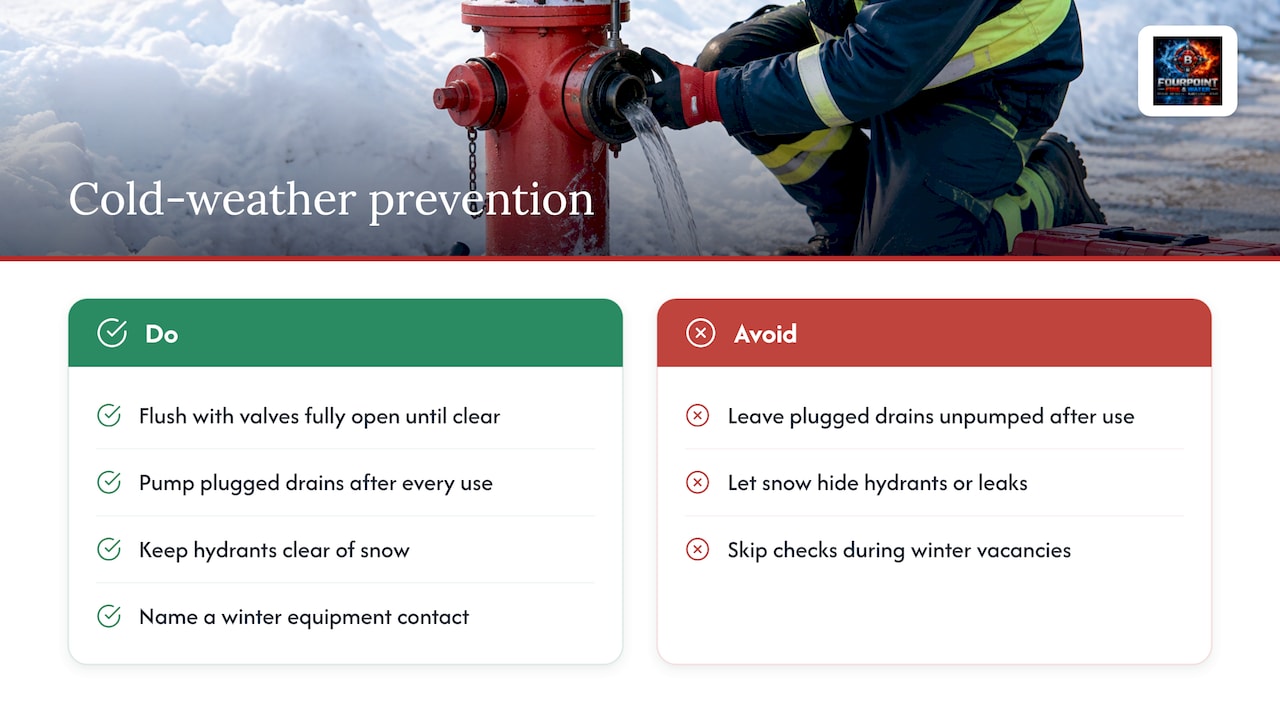
Winter vacancies. Buildings that sit empty in winter often miss routine checks, which is when a slow leak becomes ice. Planning for vacancy, such as winter vacancy planning for rental properties, should include a named person responsible for site fire protection equipment.
Maintenance before repair. Planned work is cheaper in effort than an emergency thaw, and our comparison of hydrant maintenance versus repair shows where each fits. If you are in Dawson Creek, our plan before freeze-up guide lays out the timing.
Keeping records that stand up
Every rule above ends in paperwork: annual reports to the Fire Chief, certification to the municipality, records held for three years in Fort St. John. A useful hydrant record notes the location, the date, what was found, what was repaired and the pressure and flow results. When a hydrant freezes, that history shows whether the cause is a new failure or a known one, such as a plugged drain, that was never fixed. Our service includes region-specific compliance and recordkeeping support, so the report that goes to the fire department matches what was found on site.
Who handles this for you
Owners with a few hydrants and municipalities with hundreds face the same problem: the work is seasonal, urgent when it fails and documented for the authority. We take on private hydrant maintenance, municipal hydrant maintenance programs, hydrant inspection, hydrant maintenance, repair, replacement, installation and underground hydrant repairs. Our services include inspection, installation, maintenance, design and consulting, and we work on fire hydrants, sprinkler systems, standpipes, backflow prevention, cross-connection control and related underground piping.
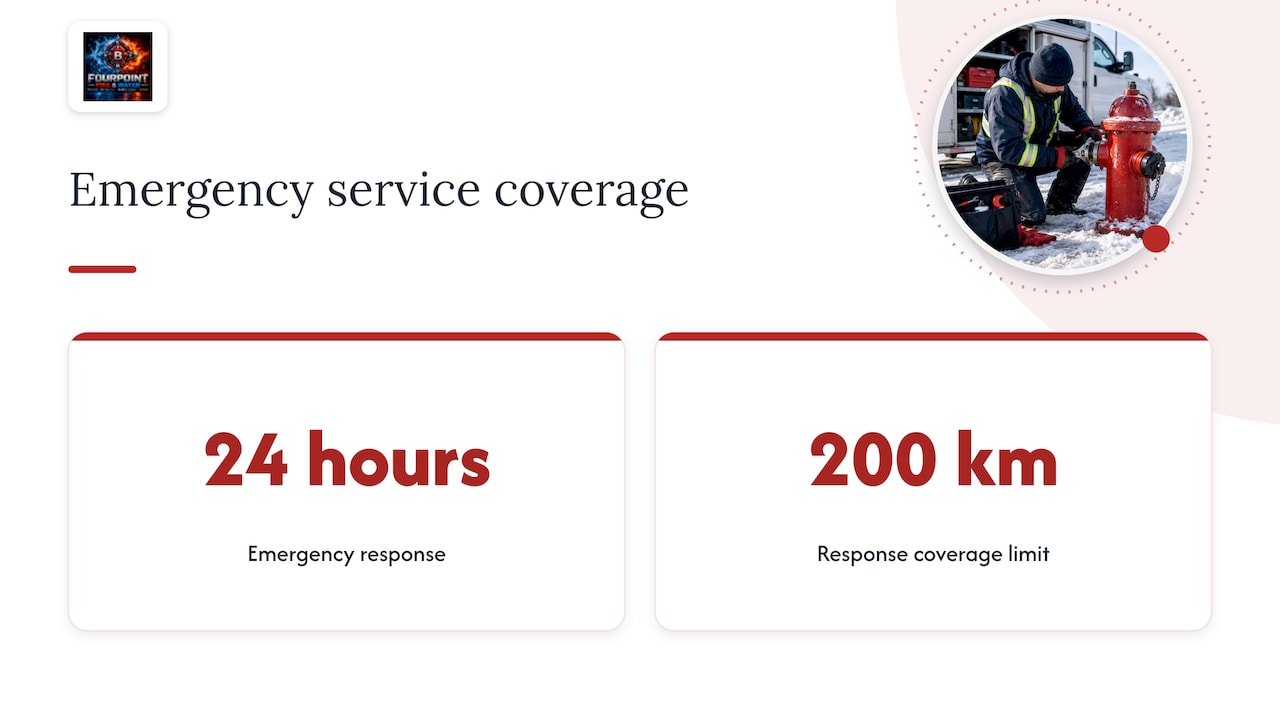
For frozen hydrants and winter failures, we offer 24 hour emergency response for locations within 200 km. Our service focus is Grande Prairie, Dawson Creek and the Peace Region, so contact us to confirm availability for your location. Our hydrant services page lists everything we do on hydrants.
If you manage a site with hydrants in the Peace Region, an inspection before freeze-up means you know which hydrants drain properly and which need work, with the records already in hand.
Our view from the trade
A frozen hydrant is almost never a bad-luck event. Water was sitting where it should not have been, and it was there because a valve seat, a drain or a drain field was not doing its job. If we only thaw it, the same hydrant is likely to freeze at the next cold snap.
That is why we start with a site assessment and the equipment itself: what type of hydrant it is, how it drains, where the groundwater sits and how it has been operated. We lay out the scope and the context with the owner before any work is arranged, because a property manager can only make a good decision when the picture is clear.
Our advice to owners is to treat the fall inspection as the freeze prevention. Flush it, check that it drains, clear the access and keep a written record. If one fails, report it, cover it and call us early.
Kevin
FAQ
Can I thaw a frozen fire hydrant myself?
We do not recommend it. Open flame can damage the hydrant and barrel, and chemical methods such as quicklime need immediate flushing to prevent corrosion. A qualified technician can thaw the hydrant, pump out the barrel and test it, and you still need to report the impairment.
Who do I report a frozen private hydrant to in BC?
Report it to your local fire department or Fire Chief, and to the municipality if its bylaw requires it. Pemberton and Fort St. John both require owners to report deficiencies or out-of-service status promptly. Tell your insurer too, with the location and expected duration.
How often should private hydrants be inspected in BC?
The BC Fire Code, as summarized by Kelowna, calls for inspection and flushing at least every 12 months and after each use. Many municipalities set a window, such as March 15 to May 15 in Kamloops and Pemberton. Our guide on how often hydrants should be inspected covers the local pattern.
Can you respond to a frozen hydrant outside business hours?
We offer 24 hour emergency response for locations within 200 km. Contact us to confirm availability for your location.
Sources
- Fire hydrants, City of Kelowna
- Fire Hydrant Inspecting & Testing Standard, City of Kamloops
- Fire Hydrants, City of Kamloops
- Village of Pemberton Fire Prevention Bylaw No. 744
- City of Fort St. John Fire Prevention Bylaw
- Waterworks Bylaw No. 2343, City of Pitt Meadows
- Fire Hydrants Inspection and Maintenance Policy, District of Lake Country
- Fighting Fires in Cold Weather, Firehouse
- Trainer’s Corner: Cold weather operations, Fire Fighting in Canada
- Risk Management Alert on fire hydrants, Utica National