A standpipe is fixed piping inside a building with hose connections that put firefighting water on the floors where it is needed, so crews do not have to lay hose from the street to a remote storey. NFPA describes this as avoiding the delay and difficulty of running hose from apparatus to remote areas, especially in tall or large buildings. Two separate questions define any standpipe: how water reaches it (the system type) and who uses the outlets (the class). Mixing the two up is the most common source of confusion in inspection reports and design drawings. At FourPoint Fire & Water, our services include inspection, installation, maintenance, design and consulting for standpipes, and we work on fire hydrants, sprinkler systems, standpipes, backflow prevention, cross-connection control and related underground piping in Grande Prairie, Dawson Creek and the Peace Region.
TL;DR
- System type describes the water: wet or dry piping, and automatic, semiautomatic or manual supply. Class describes the users and hose outlets: Class I, II or III.
- Class I is for firefighters (65 mm outlets), Class II is for trained occupants or first responders (40 mm hose stations), and Class III provides both.
- Code adoption is provincial. The National Fire Code of Canada is a model code, so confirm what your province and municipality have adopted before specifying or renewing a system.
- Standpipes are inspected, tested and maintained as part of an ongoing routine, and the fire department connection (FDC) and the hose valves are part of that routine.
- Contact us to confirm availability for your location. We provide 24 hour emergency response for locations within 200 km.
Table of Contents
- Two ways to describe a standpipe
- System types: wet, dry and how they are supplied
- Classes: what Class I, II and III mean
- The fire department connection and how it relates
- What the codes say about requirements
- Choosing the right arrangement
- Inspection, testing and maintenance
- Standpipes and the hydrants outside
- Where FourPoint fits
- Our view from the trade
- FAQ
- Sources
Two ways to describe a standpipe
Owners often ask for “the type” of standpipe in a building and get an answer that mixes categories. The cleaner way to read a system is to answer two questions separately.
- How does water get to the outlets? This is the system type: wet or dry, and automatic, semiautomatic or manual.
- Who is the outlet for, and what hose connection does it carry? This is the class: I, II or III.
NFPA’s technical-services engineer makes the same point in his explanation of standpipe design: class tells you the intended user and hose provisions, while wet or dry and automatic or manual tell you how the system operates. A building can therefore have, for example, an automatic wet Class III system. The two labels are not alternatives to each other.
System types: wet, dry and how they are supplied
The 2024 edition of NFPA 14, the standard for installing standpipe and hose systems, distinguishes five arrangements:
| Type | Piping normally holds | How water arrives | Typical consequence for the owner |
|---|---|---|---|
| Automatic wet | Water | Continuously connected to a supply capable of meeting system demand | Opening a hose valve gives water immediately |
| Automatic dry | Pressurized air or nitrogen | Water is admitted when a hose valve opens | Air pressure and the dry valve need regular attention |
| Semiautomatic dry | Air or empty | Water is admitted after a remote activation device is operated | Activation devices are part of the inspection |
| Manual wet | Water | The piping is water-filled but relies on the FDC for the system demand | The fire department supplies the demand |
| Manual dry | Air, no permanent supply | No permanent water supply; the fire department pumps in through the FDC | Nothing flows until the fire department connects |
In plain terms, “wet” and “dry” refer only to what is in the pipe on an ordinary day. “Automatic”, “semiautomatic” and “manual” refer to how the water supply is provided and activated.
Why dry systems exist in the Peace Region
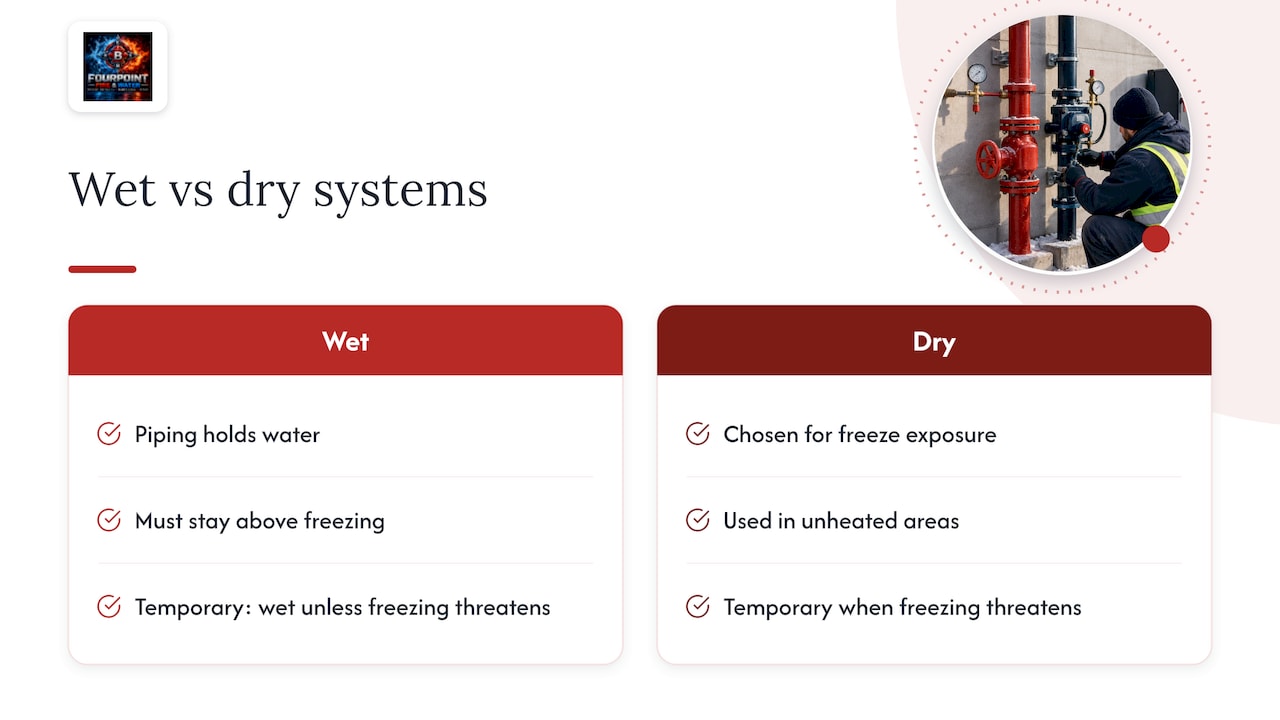
Piping that holds water must be kept above freezing. Unheated stairwells, parkades, loading docks, rooftop connections and outbuildings are the usual places where a dry system is chosen instead of a wet one. A frozen, burst riser is a failure that is found when it is needed, which is why freeze exposure is a design question and not only a maintenance one. British Columbia plan-review guidance for construction standpipes reflects the same logic: temporary standpipes must be wet unless freezing is a threat.
Dry systems come with their own routine. If you also have dry pipe sprinklers, the upkeep follows a similar pattern, which we describe in our guide to dry pipe sprinkler maintenance.
Classes: what Class I, II and III mean
NFPA 14 (2024) defines the classes by the hose connections provided and the people they are intended for, as summarized in the standard’s text:
| Class | Outlet size | Intended user | Where you tend to see it |
|---|---|---|---|
| Class I | 65 mm (2½ in.) hose connection | Fire department and those trained in heavy hose streams | Stairwells and exits of larger buildings, roofs |
| Class II | 40 mm (1½ in.) hose station | Trained building personnel or first-response firefighters | Hose cabinets in corridors and common areas |
| Class III | Both 65 mm and 40 mm | Both groups | Buildings that need both provisions |
A few practical points follow from this.
- Class I is the firefighter’s tool. The large connection is for fire department hose lines, which is why access, signage and unobstructed stairwells matter.
- Class II depends on people and equipment being ready. The hose, nozzle and rack in a cabinet only help if staff are trained and the cabinet is complete.
- Class III combines the two, so its inspection scope is the sum of both.
The fire department connection and how it relates
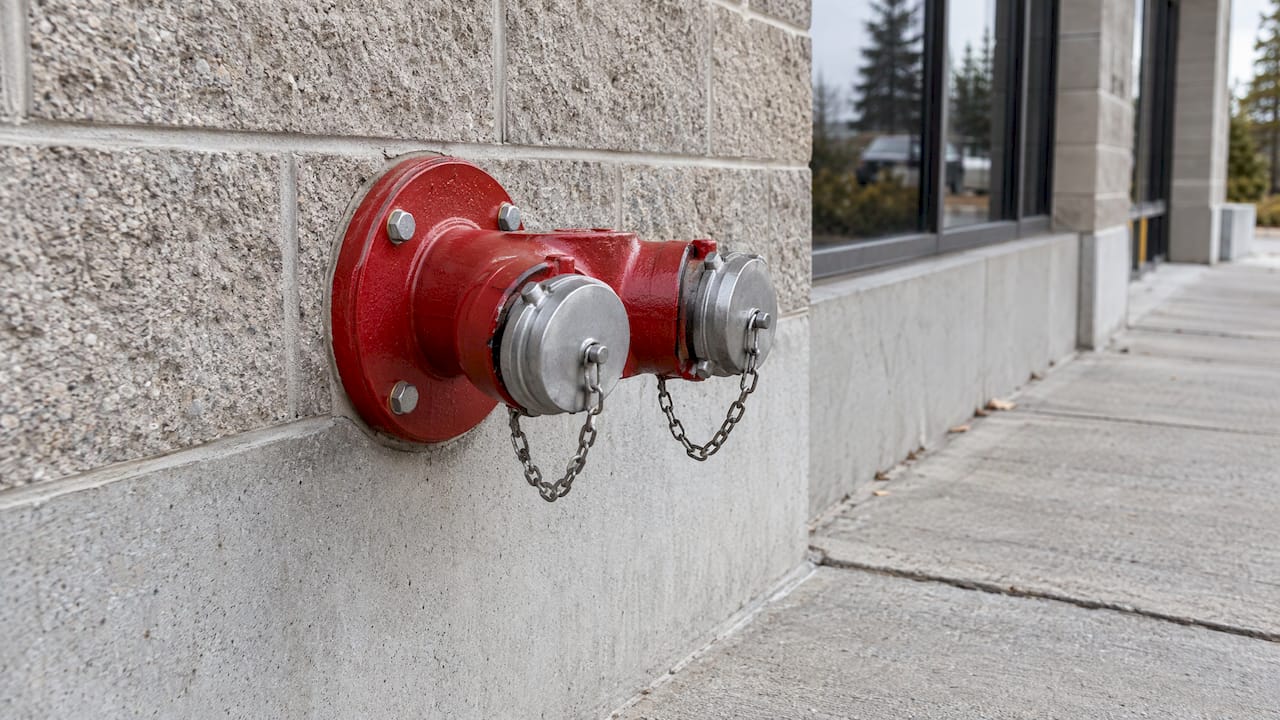
The fire department connection (FDC) is the inlet, usually on the exterior wall near street level, where the fire department pumps water into the system. It is not a standpipe itself. It is the part that lets responders supply and boost the system, and it matters to every type in the table above. In a manual dry system it is the only source of water, so it is the heart of the design.
Ontario’s 2024 Building Code is explicit that each standpipe system requires an FDC, and that a dry standpipe with no water supply does not satisfy the standpipe requirement. For an owner, the practical takeaway is that the FDC needs to be visible, unobstructed, with intact caps and a clear approach for apparatus.
What the codes say about requirements
Canada does not have one national legal standpipe rule. The National Fire Code of Canada 2025 is the twelfth edition, published in 2025, and it is a model code: each province or territory decides what is adopted and with what changes. The requirement to install a standpipe is therefore a local answer, and the examples below show how much it varies.
- Ontario: the 2024 Building Code, in force since January 1, 2025, requires standpipes in buildings above three storeys, more than 14 m to the top-storey ceiling, or certain lower buildings whose area exceeds table limits unless sprinklered throughout, with stated exceptions. Design, installation and testing are to conform to NFPA 14 apart from specified provisions. The province’s presentation says the changes harmonized standpipe provisions with the National Building Code and NFPA 14.
- Québec: the public-building safety regulation requires standpipes in combustible buildings without sprinklers over four storeys and in buildings over seven storeys. It also requires hose stations on each storey, identified and within easy reach, with hose long enough to come within 9 m of any point when fully extended.
- British Columbia: municipal plan-review notes show the requirement applying during construction too. West Vancouver’s June 2025 comments say that before work proceeds above grade, a full-demand water supply must be connected and the standpipe and FDC must meet BCFC 5.6.1.6.
For Alberta properties, the question is which edition of the Alberta Building Code and Alberta Fire Code applies to your building and what you must maintain. Our overview of the Alberta Fire Code and what building owners must maintain covers that, and for a new installation, a design review before work is planned is the point at which the local authority’s requirements get settled.
Choosing the right arrangement
The class and type usually come from the building’s design, not from owner preference, but owners are involved whenever a change of use, an addition or a replacement is on the table. These are the questions that settle the choice:
- Who will use the outlets? If only the fire department is expected to, Class I is the baseline. If trained staff will respond, Class II or III enters the discussion.
- Is any part of the piping exposed to freezing? Unheated areas push the design toward dry piping or a dry portion of the system.
- Is a reliable, adequate water supply available at the building? Automatic arrangements need a supply that can meet system demand. Where it cannot, a manual arrangement relies on the fire department pumping through the FDC.
- Is the building sprinklered? Sprinkler protection can change whether a standpipe is required at all in some jurisdictions, as the Ontario and Québec provisions above show.
- How will the system be tested and maintained? A dry system, a remote activation device or a Class II cabinet each adds specific inspection items.
Because this decision ties together design, code and long-term upkeep, we treat it as a site assessment first. Our approach is to evaluate the building, its equipment and how it is operated before any work is arranged, so that scope and context are settled in advance.
Inspection, testing and maintenance
Once a standpipe is in service, the owner’s responsibility is to keep it operable. Ontario’s Fire Code is a useful published example of what that looks like in practice. O. Reg. 213/07 requires standpipe systems to be maintained in operating condition, recognizes NFPA 25 inspection, testing and maintenance provisions, and calls for:
- monthly checks of hose stations;
- annual inspection of hose valves and hose;
- inspection of fire department connections;
- specified hydrostatic and flow and pressure tests, with a five-year maximum interval for hydrostatic testing of dry piping.
Alberta and other provinces set their own schedules through the codes they adopt, so use the list above as a picture of the kind of work involved, not as your local rule. Our guides explain the field side in more detail: what to expect from a standpipe inspection and the standpipe flow test, including requirements, procedure and how to read results.
Common findings to look for between inspections
- Hose cabinets that are locked, blocked or missing equipment.
- Hose valve caps missing or valves leaking.
- An FDC with damaged caps, debris in the inlet or a blocked approach.
- Closed or partly closed control valves.
- Signs of freezing damage in exposed piping before winter.
Keep dated records of each inspection and test. They show the authority having jurisdiction and your insurer that the system has been kept in service, and they make the next service visit faster.
Standpipes and the hydrants outside
A standpipe is only as useful as the water behind it, and that supply often comes through the same underground piping that feeds private hydrants on the property. A building with a well-kept standpipe and a seized or frozen private hydrant has a gap in its protection. That is why we look at standpipes, fire hydrants and underground piping together. If you manage a site with private hydrants, our hydrant inspection checklist for the Peace Region and our note on how often hydrants should be inspected are the place to start. For the supply side, hydrant pressure testing explains what the numbers mean. Where a fire line connects to the domestic water supply, backflow prevention and cross-connection control come into play as well.
Where FourPoint fits
Our work covers fire hydrants, sprinkler systems, standpipes, backflow prevention, cross-connection control and related underground piping, with a particular focus on fire hydrants. For standpipes that means inspection, installation, maintenance, design and consulting, led by Kevin Ballantyne, a Red Seal Journeyman Sprinkler Fitter who entered the trade in 2001 and earned his journeyman ticket in 2014.
If you are trying to establish what class and type your building has, or what a replacement should be, start with a conversation about the site. See our standpipe systems page, or reach us through fourpointfire.com to confirm availability for your location. We provide 24 hour emergency response for locations within 200 km.
Our view from the trade
Most of the confusion I see on standpipes is a vocabulary problem. People say “wet standpipe” when they mean “Class III”, or “dry” when they mean “the fire department supplies it”. Once the system type and the class are written down separately, the rest of the conversation gets easier: what has to be tested, who needs access, and what the building’s water supply has to do.
Our approach is to start with the site and the equipment in front of us, and to agree scope, context and equipment details before any work is arranged. That is how we think inspection, maintenance and design should work for property managers, industrial operators and municipalities, and it is why we like to look at the standpipe, the FDC, the hydrants and the underground piping as one picture.
If you are unsure what your building has, send us the address and we will tell you what we need to see.
Kevin
FAQ
What are the main types of standpipe systems?
The main types are automatic wet, automatic dry, semiautomatic dry, manual wet and manual dry, as set out in NFPA 14. Wet or dry refers to what is in the piping, and automatic, semiautomatic or manual refers to how the water supply is provided and activated. Your building’s design documents will say which one you have.
What is the difference between standpipe classes and types?
Class I, II and III describe the intended users and the hose outlets provided. Types describe how the system is filled and supplied with water. A single building can combine any class with a compatible type.
Is a standpipe the same as a fire department connection?
No. The standpipe is the piping and hose outlets inside the building. The FDC is the inlet on the outside where the fire department pumps water in. Both are inspected, and in manual systems the FDC is the only way water enters.
Who sets standpipe installation requirements in Canada?
The National Fire Code and National Building Code are model codes, and each province or territory adopts them with its own changes. Ontario, Québec and British Columbia each word the requirement differently, so confirm with your local authority and with us before planning work.
Do you service standpipes outside Grande Prairie?
Our focus is Grande Prairie, Dawson Creek and the Peace Region. Contact us to confirm availability for your location. We provide 24 hour emergency response for locations within 200 km.
Sources
- Standpipe System Design and Calculations, NFPA
- NFPA 14 (2024), Standard for the Installation of Standpipe and Hose Systems
- National Fire Code of Canada 2025, Government of Canada publication record
- Ontario Building Code 2024, Volume 1
- Building Code Harmonization, Ontario Ministry of Municipal Affairs and Housing
- Public Building Safety Regulation, article 30, Légis Québec
- Plan Check Comments, Port Coquitlam Fire & Emergency Services
- Plan Check Comments, West Vancouver Fire & Rescue Services
- O. Reg. 213/07 Fire Code, Ontario