Low pressure in a commercial fire sprinkler system means the system may not deliver water the way it was designed to when a fire starts. The cause is usually one of a short list: a closed or partly closed valve, an obstruction or weakness in the incoming water supply, a leak, frozen or damaged piping, or, on dry systems, a loss of air pressure. Staff can read gauges and confirm valve positions. Finding the cause, testing the supply and repairing the system belong to a qualified fire protection contractor. At FourPoint Fire & Water, our work covers sprinkler systems, fire hydrants, standpipes, backflow prevention, cross-connection control and the underground piping that feeds them, so a low-pressure reading can be traced from the gauge back to the water source.
This guide is for property managers, building owners, industrial facility teams and municipal staff. It explains what a low reading means, what you can check safely, what the codes expect and when to bring in a contractor.
TL;DR
- Low pressure is a symptom. The usual causes are a shut or partly shut valve, an obstruction or deteriorated water supply, a leak, frozen piping or, on a dry system, lost air pressure.
- Gauges at the control valve and the main drain are the main reading points. A main-drain residual pressure that has dropped more than 10% from the original installation test calls for investigation.
- Staff can safely read gauges, confirm valves are sealed open and record the numbers. Notify the fire department, occupants and the alarm monitoring company before any testing or repair.
- Repairs, flow testing and anything that impairs the system should go to a qualified, certified contractor.
- We service the Grande Prairie, Dawson Creek and Peace Region areas and offer 24 hour emergency response within 200 km. Contact us to confirm availability for your location.
Table of Contents
- What low pressure means in a fire sprinkler system
- Common causes of low sprinkler system pressure
- How to tell whether a reading is actually low
- What staff can safely check
- When it needs a qualified contractor
- Notifying the right parties and keeping records
- How routine inspection prevents low pressure
- Where the supply is the problem: hydrants and underground piping
- Our approach to a low-pressure call
- Getting help in the Peace Region
- FAQ
- Sources
What low pressure means in a fire sprinkler system
A fire sprinkler system has two pressures worth understanding. The first is water supply pressure: the pressure of the water arriving from the municipal main, a private hydrant loop, a tank or a fire pump. The second is system pressure: the pressure inside the sprinkler piping itself. In a wet system the pipes are full of water. In a dry system the pipes hold compressed air, and a dry pipe valve holds the water back until a sprinkler head opens and the air pressure falls.
Because there are two pressures, “low pressure” can mean different things on different systems. On a wet system it normally points to the water supply or to a restriction between the supply and the gauge. On a dry system it can mean the air side has dropped, which, as we explain below, is a performance concern and not just a gauge reading.
The Canadian Fire Safety Association notes that gauges, although minor components, are the primary tool for spotting closed or broken isolation valves, obstructions on the incoming supply and deteriorated water supplies during NFPA 25 inspections. NFPA 25 is the standard for inspection, testing and maintenance of water-based fire protection systems, and Canadian fire codes lean on it.
Common causes of low sprinkler system pressure
The causes fall into a few groups. Knowing which group you are in tells you who should respond.
Valve position
A closed or partly closed control or isolation valve is among the most common reasons for a low reading and also one of the easiest to miss. NFPA 25 includes an impairment tag example for exactly this: a shut control valve, and a low pressure reading during a flow test that may point to a partially shut valve or an obstruction in the supply. Valves get closed during renovations, after a repair and during tenant work, and are sometimes not reopened fully.
A valve that is closed leaves the system out of service. That is an impairment, and it should be handled as one (see the notification steps further down).
Obstruction or deterioration on the water supply
The supply side includes the underground main, the lead-in pipe, private hydrants and any backflow assembly on the line. Tuberculation, sediment, debris, a partly closed underground valve or a damaged section can all reduce the water that reaches the building. These problems do not show up on the building’s gauges until the supply is tested, which is why the comparison against the original installation test matters.
Where a property has private hydrants on the same loop, the hydrants and the underground piping are part of this picture. Our hydrant pressure testing guide explains what a hydrant flow test measures and how that feeds into decisions about the supply.
Leaks and system damage
Leakage reduces pressure and, in the worst case, empties piping. NFPA 25’s impairment guidance lists system leakage, interruption of the water supply, frozen or ruptured piping and equipment failure as emergency impairments that require written notification to the owner. If you suspect a leak, the water damage side of the problem matters as much as the pressure. We cover that in sprinkler water damage: causes and prevention.
Cold weather
In the Peace Region, freezing is a real driver of failures. Ice can block or split piping, damage valves and trip a system that was holding steady the week before. Ecclesiastical’s 2023 Canadian guidance on sprinkler freeze-ups and malfunctions recommends that winterization inspections start in the fall and that valve and pump rooms are kept above 4 °C. Hydrants on a private loop are exposed in the same way, and our guide to fire hydrant parts that matter in cold weather covers what to look at before the ground freezes.
Air pressure on dry systems
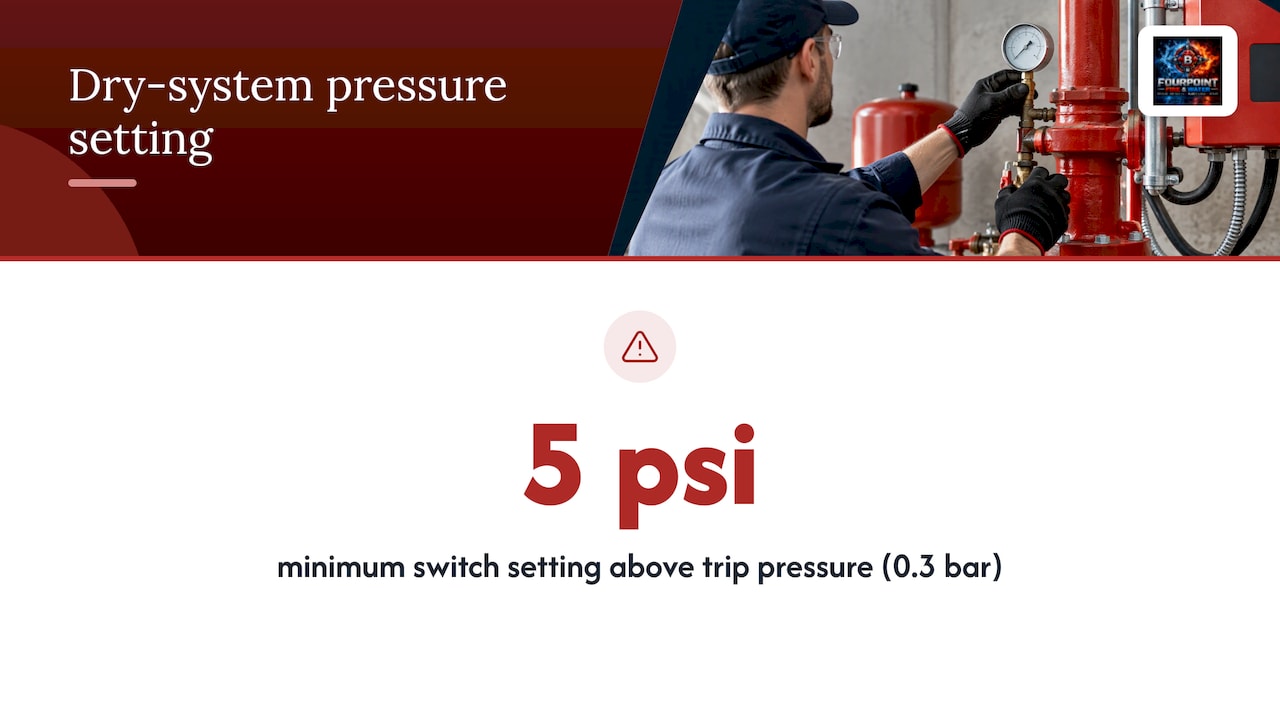
Dry systems depend on compressed air to hold the dry pipe valve closed. Under NFPA 13, the installation standard, each dry pipe valve is to have a supervisory pressure switch, with the low pressure signal set at a minimum of 5 psi (0.3 bar) above the trip pressure of the dry pipe valve. The same standard sets how quickly water must reach the test connection after a trip. Low air pressure that changes trip behaviour therefore affects performance, not just a reading.
Ecclesiastical also points out that a dry system can fill with water after a valve failure, producing only an intermittent low pressure signal that should not be overlooked. If a low-pressure or trouble signal comes and goes, treat it as real. Our dry pipe sprinkler maintenance guide sets out the schedule, trip tests and upkeep for these systems.
How to tell whether a reading is actually low
A gauge number means little without something to compare it to. There are two comparisons that matter.
- The original acceptance test. When a sprinkler system is installed, its water supply is tested and the results recorded. The Canadian Fire Safety Association states that main-drain residual pressure should not degrade more than 10% from the original installation test, and that a bigger change needs further investigation.
- The previous year’s result. This is useful, but a slow decline can hide in year-over-year comparisons. A small drop each year can add up to a large drop from the acceptance figure, so keep the original number in the system file.
A main drain test is how that comparison is made. The test records static pressure with the drain closed, then residual pressure with the drain fully open, then the return pressure after closing it slowly. It is a flow test and it moves a lot of water, so it is done with the right notifications and drainage in place and, for most properties, by the contractor.
Worked example
Suppose the acceptance test recorded a main-drain residual pressure of 60 psi. Last year’s test showed 57 psi, which looks like a drop of 5%. This year it reads 53 psi. Against last year that is about 7%, which looks modest. Against the acceptance figure it is a drop of about 12%, which is past the 10% trigger. Only the original number reveals that. The next step is an investigation of the supply for a partly closed valve, a blockage or a deteriorated main, which is work for a contractor with the ability to test and open up the underground piping.
What staff can safely check
Routine checks by trained building staff are part of how these systems are kept in order. The Town of Georgina’s 2025 sprinkler maintenance record, which refers to the Ontario Fire Code and NFPA 25, lists the pattern. Weekly checks confirm valves are sealed or locked open and that dry-pipe air pressure gauges read the required pressure; monthly checks include alarm tests and inspection of valves that are locked open or electrically supervised. The same record says trained in-house staff or a qualified fire protection contractor can carry out the listed tests.
For a low-pressure concern, a reasonable first pass looks like this:
- Read and record the gauges. Note the water supply gauge and the system gauge at the control valve, with the date and time. Compare against your last readings and the acceptance figure.
- Confirm valve positions. Check that each control valve is fully open and sealed or locked in that position, and that supervised valves show normal at the panel.
- Look for visible leaks and damage. Wet floors, corrosion at fittings, ice in unheated areas and heads that look damaged are all reasons to call.
- Check heat in valve and pump rooms during cold weather.
- Note any trouble signals on the fire alarm panel, including ones that clear on their own.
Do not open the main drain, bleed the system or operate valves you cannot confirm are safe to move without a plan. Closing a valve to investigate puts the system out of service. The Georgina record is explicit that the fire department, occupants and the alarm monitoring company are to be notified before testing or repairs.
When it needs a qualified contractor
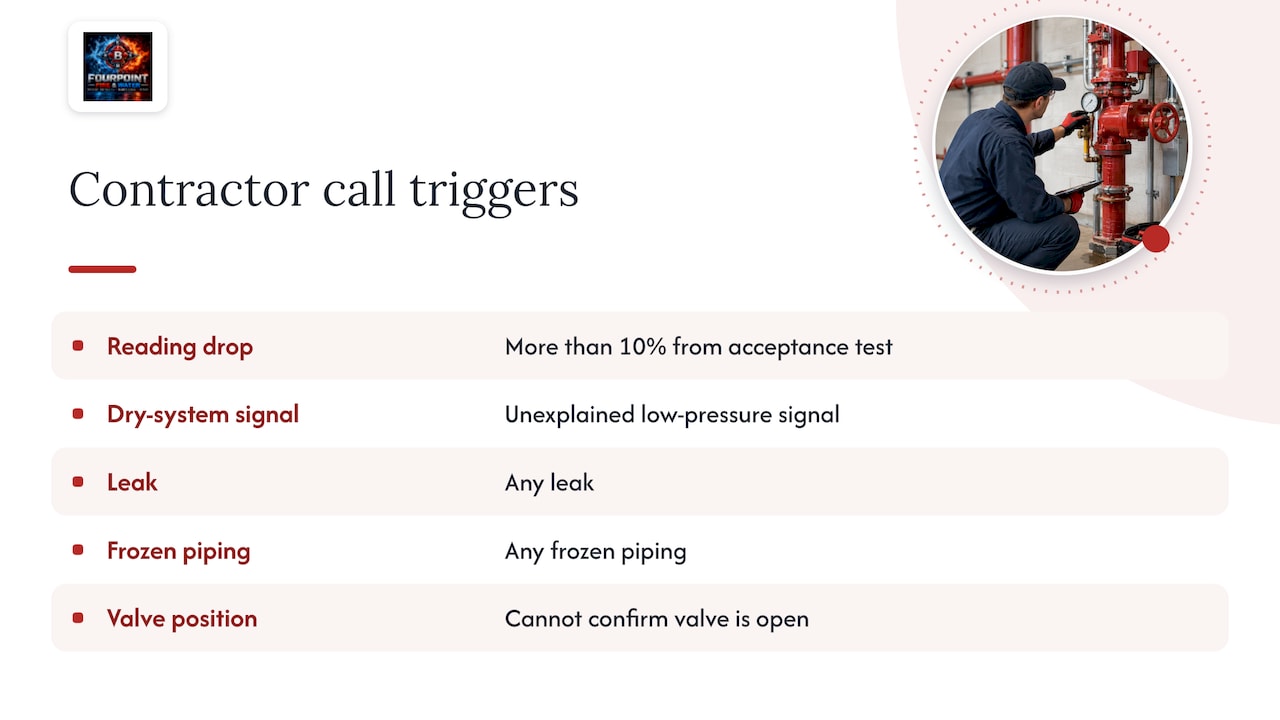
A reading that has dropped more than 10% from the acceptance test, a low-pressure signal on a dry system that you cannot explain, any leak, any frozen piping and any valve you cannot confirm is open are all calls to a contractor. So is anything that would require shutting the system down.
The code expects this. Under the City of Mission’s Fire Prevention Bylaw 6258-2023, for example, service agencies whose technicians are certified by ASTTBC, the Canadian Fire Alarm Association or a recognized certification agency must test, inspect or maintain fire protection equipment, and owners must notify the Fire Department when fixed fire protection equipment is inoperable or out of service. Bylaws differ by municipality, so confirm the rule that applies to your property with your local fire department or authority having jurisdiction.
NFPA 25 defines qualified personnel as people who have met the training and requirements for the field in a way the authority having jurisdiction accepts. In practice, that means a contractor with certified technicians and the ability to document the work.
Alberta, British Columbia and Ontario
Requirements come from the provincial fire code and the local authority, and the Peace Region spans two provinces. Alberta issued joint code bulletin 23-BCB-005 / 23-FCB-003 on sprinkler systems with antifreeze solutions in January 2025, which is worth knowing about if your system uses antifreeze. For a worked-out example of a Canadian code’s wording on pressure, the Ontario Fire Code (O. Reg. 213/07) requires weekly gauge checks of water supply and system air or water pressure under section 6.5.3.2, and annual main-drain water supply pressure tests under 6.5.5.5. It also treats compliance with NFPA 25 as meeting its inspection requirements. These are Ontario sections, quoted as an example of the standard’s reach, so check the Alberta or British Columbia code and your local bylaw for your own property.
Notifying the right parties and keeping records
When a system is impaired, the checklist is as important as the repair. Based on the Georgina record and NFPA 25’s impairment guidance:
- Notify the fire department, building occupants and the alarm monitoring company before testing or repair work that takes the system down.
- Tag the impaired valve or system so nobody assumes it is in service.
- Notify the owner in writing where the impairment is an emergency type such as leakage, interrupted supply or frozen piping.
- Restore the system, confirm valves are open and sealed, and notify the same parties that it is back in service.
- File the readings, the cause found and the corrective work, together with the acceptance test numbers.
A clean record answers an inspector’s questions and makes the next low-pressure reading far easier to interpret.
How routine inspection prevents low pressure
Most low-pressure problems that become emergencies were visible earlier. The Georgina schedule runs weekly valve and air gauge checks, monthly alarm tests, priming-water checks on dry systems at least every three months and supervisory-device tests at least every six months. Ecclesiastical advises that water supply and system pressure gauge readings be checked daily, with at least weekly readings recorded, and that the sprinkler maintenance company be contacted immediately if an alarm trips without a full alarm condition.
In short, a short weekly routine by your staff and a scheduled inspection by a contractor together catch the closed valve, the slow decline and the frozen section early.
Where the supply is the problem: hydrants and underground piping
When a building’s pressure drops, the cause is often outside the walls. A private hydrant loop, a buried valve or a section of underground main can restrict what reaches the sprinkler riser. Because hydrants sit on the same supply, hydrant flow and pressure testing is a practical way to see what the water source is delivering. For a property with private hydrants, a regular routine of inspection, flushing and operation keeps that supply dependable and documented. Our fire hydrant inspection checklist for the Peace Region lays out what to look at, and winter-related failures, such as frozen hydrants, are part of the same program.
Our approach to a low-pressure call
Kevin Ballantyne, our owner, is a Red Seal Journeyman Sprinkler Fitter who entered the trade in 2001 and earned his journeyman ticket in 2014. Our process starts with a site-specific assessment: the system type, the equipment, the operating context and the supply, with scope and equipment details settled before any work is arranged. We cover inspection, installation, maintenance, design and consulting.
Perspective
When a manager calls about low pressure, the first question we ask is whether anyone knows what the reading used to be. A gauge on its own tells you very little. The acceptance test number, the last few years of readings and the valve positions tell us where to start, and that is why we push owners to keep them in one file.
We also look past the building. A great many pressure complaints begin in the underground piping, a private hydrant loop or a valve nobody has operated in years, so we work on the sprinkler riser, the hydrants, the standpipes, the backflow assemblies and the buried piping together. That lets one site assessment cover the whole path the water takes.
Our advice is simple: read your gauges weekly, record them, and call when the numbers move. We would rather help you sort out a small change in the fall than respond to a frozen line in January, though we do offer 24 hour emergency response for locations within 200 km.
Kevin
Getting help in the Peace Region
We provide fire hydrant, sprinkler, standpipe, backflow prevention and cross-connection control service, along with related underground piping work, for commercial, industrial and municipal properties in Grande Prairie, Dawson Creek and the wider Peace Region. For a pressure concern, the relevant pages are fire sprinkler inspections, fire sprinkler repairs and hydrant troubleshooting. If you are planning new work, our guide to sprinkler installation in the Peace Region explains the project steps, and what to do next about sprinkler repair in Grande Prairie covers the first calls to make.
Contact us through our main site with your location, the system type and the readings you have recorded, and we will confirm availability for your property.
FAQ
Is a drop in sprinkler pressure an emergency?
It depends on the cause. A valve found shut, a leak, frozen piping or an interrupted supply are treated as impairments that call for prompt notification and repair. A small, explained change may be handled at the next scheduled service. If you cannot explain a drop, call a contractor and notify your alarm monitoring company.
How much can main-drain pressure fall before I need to investigate?
The Canadian Fire Safety Association states that main-drain residual pressure should not degrade more than 10% from the original installation test. Anything beyond that needs further investigation. Always compare to the acceptance test, not only last year’s figure.
Can my own staff test the sprinkler system?
Trained in-house staff can carry out routine checks such as weekly gauge and valve inspections and monthly alarm tests, according to the Town of Georgina’s record. Repairs, flow testing and work that takes the system out of service should be done by a qualified, certified contractor, with the fire department, occupants and monitoring company notified first.
Does a low reading on a dry system mean the same thing?
Not exactly. On a dry system, low air pressure can change how fast the dry pipe valve trips and how quickly water reaches the most remote point. A low-pressure signal that comes and goes should still be checked, as it can indicate a valve problem.
Sources
- Canadian Fire Safety Association: fire sprinkler gauges
- Town of Georgina: sprinkler system maintenance record, 2025
- City of Mission: Fire Prevention Bylaw 6258-2023
- NFPA 25 (2023 edition)
- NFPA 25 (2017 edition)
- NFPA 13 (2025 edition)
- Ecclesiastical: avoiding freeze-ups and malfunctions of automatic fire sprinklers
- Ontario Fire Code, O. Reg. 213/07