A damaged hydrant is a water supply that may not work when firefighters need it. The first step is to establish whose hydrant it is: a hydrant on a public road allowance is reported to the municipality, while a hydrant on commercial, industrial or strata property is usually the owner’s responsibility to report, repair and document. We repair and replace private and municipal hydrants in Grande Prairie, Dawson Creek and the Peace Region, so this guide covers what a property manager or facility operator needs to do from the moment damage is found until the hydrant is back in service.
TL;DR
- Work out ownership first: public hydrants are reported to the municipality, private hydrants are the property owner’s to repair at their own cost in most Canadian municipalities.
- Tell the fire department promptly if a hydrant is out of service, so it can plan an alternative water supply.
- Tag the hydrant as out of service, keep it clear and keep a written record of what was found.
- Repairs range from replacing a cap or seal to excavating and replacing a barrel or main valve, and the work should be checked and flushed before the hydrant returns to service.
- Contact us to confirm availability for your location. We offer 24 hour emergency response for locations within 200 km.
Table of Contents
- What counts as a damaged or broken hydrant
- First question: whose hydrant is it?
- What to do when you find damage
- How a damaged hydrant is assessed
- Repair or replace
- Winter damage in the Peace Region
- Keep the hydrant clear, and keep records
- Our perspective
- Work with FourPoint on hydrant repairs
- FAQ
- Sources
What counts as a damaged or broken hydrant
A hydrant must be ready to deliver fire flow at a moment’s notice. Saskatoon’s hydrant guidance lists the problems inspectors look for: damage to the breakaway device (the designed weak point that lets a hydrant shear cleanly when struck by a vehicle), main-valve leakage, water or ice in the barrel, and leaks at flanges, nozzles, packing or the operating stem.
In practice, property managers usually notice one of these:
- A hydrant struck by a plow, truck or forklift, with a bent barrel, cracked flange or sheared breakaway components.
- Water seeping at the base, the nozzle caps or the stem.
- Caps that will not turn because the threads are worn, rusted or obstructed.
- A hydrant that does not drain after use and holds water in the barrel, which matters a great deal in a Peace Region winter.
- Little or no flow when the hydrant is operated.
Some of these are visible from the lot. Others, such as a leaking main valve or a failed underground connection, only show up during an inspection or a flow test.
First question: whose hydrant is it?
Ownership decides who you call and who pays. Municipalities across Canada draw the line in similar ways, although the details differ.
| Situation | Typical responsibility | Example |
|---|---|---|
| Hydrant on a public road allowance | The municipality maintains and repairs it | London’s Water By-law W-8 treats hydrants in a road allowance as City property |
| Hydrant on private commercial, industrial or strata property | The owner inspects, maintains and repairs it | Kelowna states that private hydrants are not maintained by the City |
| Private hydrant, repair costs | The owner pays | Kamloops’ fire by-law requires owners to maintain, inspect, test, repair and replace private hydrants at their own cost |
One detail from London is worth knowing. Its by-law requires damage to a private hydrant to be repaired within seven days, with damage above the break-away flange repaired by the City and damage below the flange, including the barrel, repaired by the owner.
If you manage several buildings, a plan of every hydrant, marked public or private, saves time when something is hit. If the plan does not exist, a site assessment can build it. We identify and document hydrant equipment as part of our technical site assessments, and our private hydrant inspection and maintenance service is built around that record.
A property manager who coordinates building maintenance can also write hydrant responsibility into the maintenance plan, so that it is clear who reports and who authorizes repairs. Maintenance coordination works best when each party’s responsibilities are agreed in advance.
What to do when you find damage
- Keep people and vehicles away. A hydrant that is leaking heavily can flood a lot and ice a surface in winter. Traffic control cones are enough in most cases.
- Identify the owner. Check your site plan or the municipality’s records.
- Report it. Public hydrants go to the municipality. Calgary, for example, takes reports of damaged, hit, missing or frozen hydrants through 311 or an online request, and Saskatoon runs a leaking or broken hydrant form with a 24/7 emergency line. Private hydrants are reported to the fire department and to your contractor.
- Notify the fire department that the hydrant is out of service. By-laws such as Mission’s Fire Prevention Bylaw require owners to make known hydrant conditions that affect fire safety, including hydrants out of service and low water pressure.
- Tag the hydrant. Saskatoon’s procedure is to mark inoperable hydrants with a clearly visible tag and report them.
- Photograph and record. Note the date, what happened, who was told and when. This record supports inspection reports and insurance conversations.
- Book an assessment. Repairs depend on what is actually wrong, and that is not always visible from the surface.
If your property is in the Peace Region, contact us to confirm availability for your location. We provide 24 hour emergency response for locations within 200 km.
How a damaged hydrant is assessed
A proper assessment follows the same order municipalities use. Saskatoon’s inspection procedure checks the breakaway device, listens for main-valve leakage, looks for water or ice in the barrel, flushes until the water runs clear, checks for leaks at flanges, nozzles, packing and the stem, and lubricates threads.
On a private property, the assessment should also answer questions that decide the scope of work:
- Is the damage above or below grade? Above-grade parts such as caps, nozzles and stem nuts are often a straightforward repair. Barrel, flange or underground damage can require excavation.
- Is the main valve holding? A leaking main valve fills the barrel and can freeze.
- Does the drain work? Kelowna’s guidance calls for leaking main valves and plugged or damaged drain valves to be repaired, with measures against freezing where a drain repair is impractical.
- Does the hydrant need to be isolated from the fire main, and what does that do to the rest of the building’s protection?
Our approach is to evaluate the site and the operating context first, so that scope, equipment details and conditions are understood before any work is arranged. Our hydrant troubleshooting service covers the cases where the cause is not obvious.
Repair or replace
The decision usually rests on three things: the extent of damage, the age and parts availability of the hydrant, and what it takes to reach it.
- Repair suits worn caps, seals, packing, stem components and leaking valves. Our hydrant repair page describes the signs and process.
- Underground work applies when the problem is below grade, such as a damaged connection or a leaking lateral. We do underground hydrant repairs, including excavation.
- Replacement is the answer when the barrel is cracked, parts are obsolete or repeated repairs are no longer sensible. See hydrant replacement, and hydrant installation where a new location is needed.
Work on a hydrant often means shutting down part of the fire main. That is why it needs planning and notice to the fire department, and why an emergency repair at 2 a.m. goes better when the site is already documented.
Winter damage in the Peace Region
Cold is a common cause of hydrant failure here. Water that stays in a barrel can freeze and crack components. The Ontario Fire Code, section 6.6.5.1, requires the barrel to be checked for accumulated water when the main valve is closed, and approved measures against freezing where poor drainage cannot be corrected. Although that is Ontario’s code, the same check is sound practice anywhere hydrants face frost.
If a hydrant has frozen or failed in winter, our frozen hydrant assessment looks at why it froze, not just how to thaw it, so the repair addresses the cause.
Keep the hydrant clear, and keep records
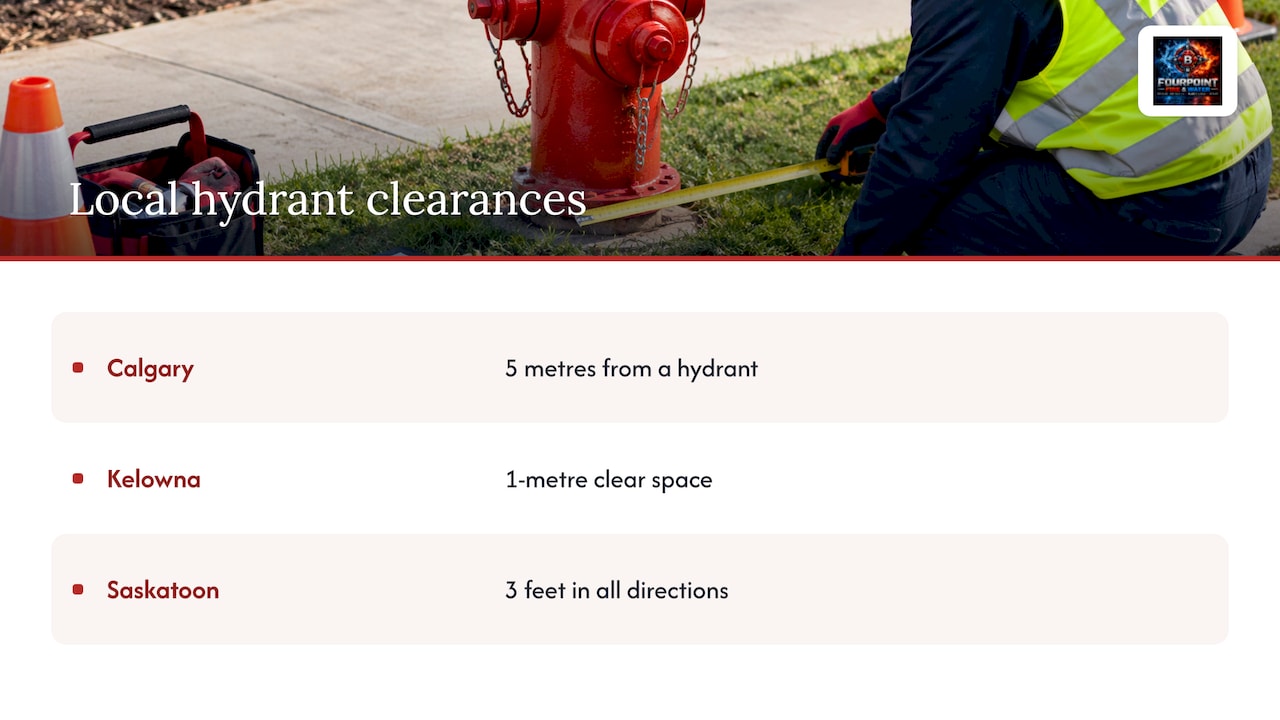
Most damage is preventable with clearance. Requirements vary by municipality: Calgary’s bylaws prohibit parking within five metres of a hydrant, Kelowna requires a 1-metre clear space, and Saskatoon’s guidance asks for 3 feet in all directions. Check your own municipality’s by-law and the Alberta, BC, Saskatchewan or Manitoba requirement that applies to your property.
Inspection frequency is also set locally. The Ontario Fire Code requires hydrants to be inspected annually and after each use, and Kelowna cites BC Fire Code intervals of no more than 12 months for private hydrants, with records submitted to the Fire Chief. Our hydrant inspection and hydrant maintenance services give you dated records that match those expectations. Flow data is useful too, and our note on hydrant pressure testing explains what it measures.
Our perspective
Most hydrant emergencies we are called to started as a small, unrecorded problem. A cap that would not turn, a slow weep at the stem, a barrel that held water. By the time the hydrant is struck or frozen, nobody can say what condition it was in.
Our approach is to assess the site and the operating context first, and to be clear about scope and equipment before any work is arranged. That is the work we do on fire hydrants, sprinkler systems, standpipes, backflow prevention, cross-connection control and the underground piping that connects them, across inspection, installation, maintenance, design and consulting.
I have worked in the trade since 2001 and earned my journeyman ticket in 2014. A damaged hydrant is rarely just a hydrant problem, and I would rather you call before it is a crisis.
Kevin
Work with FourPoint on hydrant repairs
We serve commercial, industrial and municipal clients in Grande Prairie, Dawson Creek and the Peace Region, with services led by Kevin Ballantyne, a Red Seal Journeyman Sprinkler Fitter. Our hydrant services include inspection, preventative maintenance, repair, replacement, installation, troubleshooting, excavation and municipal maintenance programs. See the full list on our fire hydrant services page, or look at our municipal hydrant maintenance programs if you manage public infrastructure.
Contact us to confirm availability for your location.
FAQ
Who do I call about a broken hydrant?
If it is on a public street, call your municipality: 311 in cities such as Calgary and Ottawa, or the local water department. If it is on private property, notify the fire department and your hydrant contractor. In an emergency, call 911 first.
Who pays to fix a private hydrant?
In most Canadian municipalities the property owner does. Kamloops and Waterloo both place inspection, maintenance and repair of private hydrants on the owner. Check the by-law where your property is located.
Is a leaking hydrant an emergency?
A heavy leak, flooding or a hydrant that has been struck should be treated as urgent, because it can affect available fire flow and cause icing or property damage. Saskatoon’s report form distinguishes pooling or flooding from a relatively small leak. Either way, record it and arrange an assessment.
Can I use a hydrant that seems fine but is damaged?
No. Operating hydrants is restricted. London’s by-law makes it an offence for anyone other than the Engineer to operate a hydrant, and a damaged hydrant should be tagged and assessed, not used.
Sources
- Saskatoon hydrant guidance (PDF)
- City of Saskatoon: Report a Leaking or Broken Fire Hydrant
- City of Calgary: Fire hydrants
- City of Kelowna: Fire hydrants
- City of London: Water By-law W-8
- City of Kamloops fire by-law
- City of Waterloo: Fire hydrants
- District of Mission: Fire Prevention Bylaw
- Ontario Fire Code, Section 6.6