A hydrant pressure test, more precisely a hydrant flow test, measures how much water a hydrant can deliver and at what pressure while the system is under demand. Standpipe pressure testing is a related but separate test of the piping inside a building. Both need calibrated equipment, a defined procedure and a written report, and both are best handled by a qualified fire protection contractor. At FourPoint Fire & Water, our services include inspection, installation, maintenance, design and consulting for fire hydrants, sprinkler systems, standpipes, backflow prevention, cross-connection control and related underground piping. Please contact us to confirm availability for your location in Grande Prairie, Dawson Creek and the Peace Region.
TL;DR
- A flow test records static pressure, residual pressure and flow to show how much water a hydrant can supply, and the results are written up in a report.
- NFPA 291 sets the method and recommends keeping residual pressure at or above 20 psi during testing. NFPA 291 says public hydrants should be flow tested at least every 5 years.
- Under NFPA 25, hydrants are also operated annually, and standpipes get a flow test and, on dry systems, a hydrostatic test every 5 years.
- Rules differ by province and municipality, so confirm what your local authority having jurisdiction (AHJ) requires.
- Pressure tests are the final proof of a hydrant that has been inspected and maintained. Good maintenance makes the result more predictable.
Table of Contents
- What a hydrant pressure test measures
- How a hydrant flow test is carried out
- Interpreting the results: pitot pressure, GPM and flow at 20 psi
- How often hydrants must be tested
- Standpipe pressure testing
- Records and failed results
- Perspective
- Working with FourPoint
- FAQ
- Sources
What a hydrant pressure test measures
People use “pressure test” for two different things, and it helps to separate them.
- Hydrant flow test: measures the pressure and volume of water a hydrant can supply from the water main. Saskatoon’s hydrant guidance describes fire flow tests as a way to determine pressure and flow-producing capabilities, and to see how much water is available for firefighting.
- Standpipe pressure test: a hydrostatic test, which means filling the piping with water at a set pressure to check strength and leaks, plus a flow test at the most remote hose outlet.
Three terms appear in every flow test report:
- Static pressure: the pressure in the system with no water flowing.
- Residual pressure: the pressure that remains at a nearby hydrant while another hydrant is flowing.
- Flow: the volume discharged, usually calculated from a pitot reading (a small gauge held in the stream) and expressed in US gallons per minute (GPM) in many Canadian reports.
Why owners and municipalities need the numbers
The results show the real capacity of the supply, and they can reveal problems in the main such as tuberculation (internal corrosion build-up) or a closed valve, according to the Saskatoon guidance. The same guidance notes that insurance underwriters and sprinkler designers use flow test results. For a property with private hydrants, that means the test supports both design decisions and insurance conversations.
Residual pressure matters for a second reason. NFPA 291 identifies as a primary concern keeping enough residual pressure to avoid negative pressure in street mains, which could collapse a main or draw polluted water back into it (back-siphonage). That is why testers watch the gauge closely while flowing water.
How a hydrant flow test is carried out
The City of Innisfil’s hydrant flow testing protocol, which follows NFPA 291, gives a clear picture of the sequence. In summary:
- Select the hydrants. One is the residual hydrant, where pressure is read. One or more are flow hydrants, where water is discharged. The layout should account for traffic, property damage and flooding, as NFPA 291 directs.
- Check valves and install equipment. Confirm the secondary valve is open and fit the gauge on the residual hydrant and a diffuser on the flow port. The protocol calls for an approved de-chlorination treatment on discharged water.
- Open the residual hydrant slowly and bleed air, then record static pressure.
- Open one port on the flow hydrant and record the pitot pressure.
- Monitor residual pressure. The protocol requires that it stay at or above 20 psi (138 kPa).
- Record residual pressure, repeat at a second port, then close everything slowly. A minimum of two sets of flow data is required.
NFPA 291 also requires enough discharge to drop residual pressure by at least 10 percent for the test to be satisfactory. Saskatoon’s guidance puts it as a drop of at least 10 psi (70 kPa) for reasonably accurate results, with an added flow hydrant if the system is strong and the drop is smaller.
Where tests go wrong
- Time of day. Street pressures can swing noticeably through the morning, so results taken at different times are not directly comparable.
- Too little discharge. A small drop in pressure gives an unreliable extrapolation.
- A hydrant that does not operate properly. A seized stem, a closed auxiliary valve or a hydrant that does not drain will stop the test or distort it.
- Uncontrolled discharge. Water has to go somewhere safe, which affects icing in winter and flooding of nearby property.
We suggest an inspection and any needed maintenance before a flow test so the hydrant is mechanically sound when it is flowed. Our fire hydrant inspection and hydrant maintenance pages describe how we approach that work.
Interpreting the results: pitot pressure, GPM and flow at 20 psi
The test gives you flow at the measured residual pressure. Ratings, however, are normally stated at a standard residual, so the number is adjusted.
NFPA 291 says hydrant ratings should be based on flow available at 20 psi residual where static pressure is over 40 psi, and at one-half of static pressure where static is below 40 psi. Saskatoon’s guidance gives an example: a hydrant with 30 psi static can be calculated down to 15 psi rather than 20 psi.
A Small Water Systems BC webinar gives the flow equation used to estimate flow at a chosen residual:
QR = QF × (hr ÷ hf)^0.54
- QR: flow at the desired residual pressure
- QF: total measured flow
- hr: pressure drop from static to the desired residual
- hf: pressure drop actually measured
A worked example
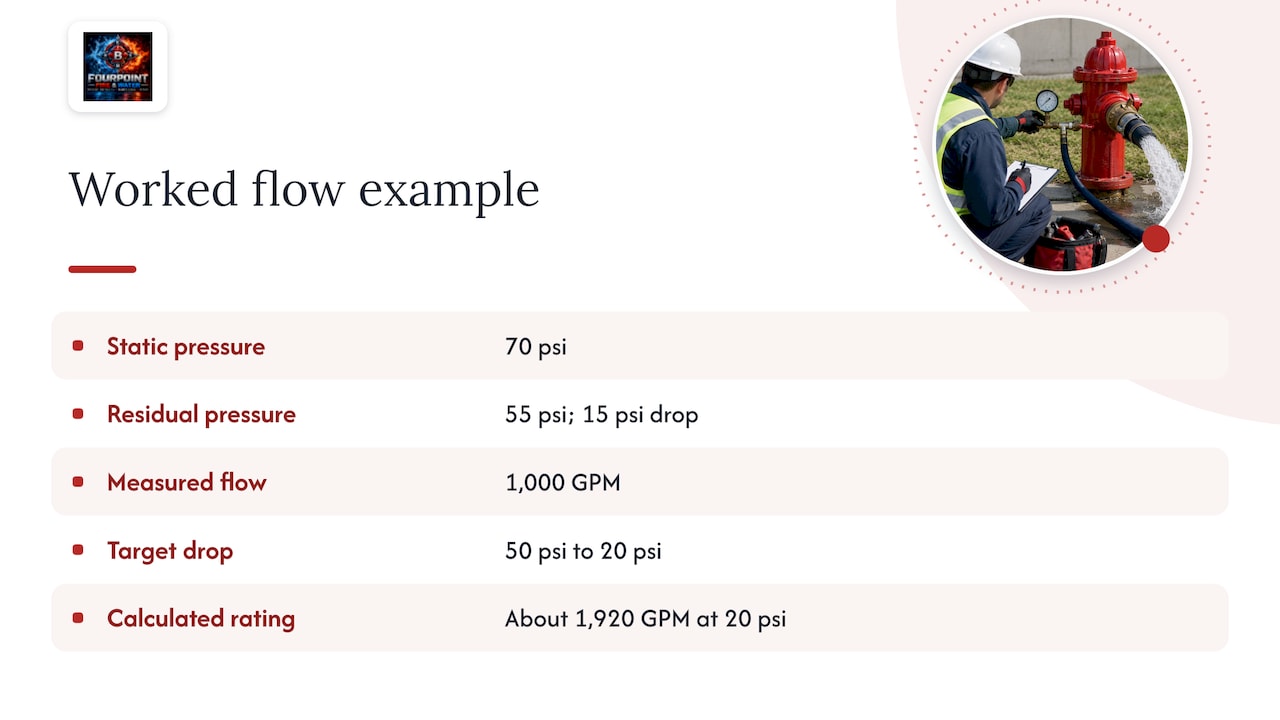
These numbers are illustrative only. Suppose static pressure is 70 psi and, with two ports flowing, residual falls to 55 psi, a drop (hf) of 15 psi, with a measured total flow (QF) of 1,000 GPM. The drop to 20 psi (hr) is 50 psi. QR = 1,000 × (50 ÷ 15)^0.54, which is 1,000 × 1.92, or about 1,920 GPM at 20 psi. Note how far the estimate extends beyond what was measured. That is why a meaningful drop during the test matters.
How often hydrants must be tested
Frequency comes from the standard your AHJ adopts. In Canadian practice, these are the benchmarks:
| Item | Interval | Source |
|---|---|---|
| Public hydrant flow test | At least every 5 years | NFPA 291 |
| Hydrant operation (opened fully, flowed at least 1 minute, drainage within 60 minutes) | Annually | NFPA 25 |
| Hydrant flow test under NFPA 25 | At minimum 5-year intervals | NFPA 25 |
| Whole distribution system flow testing (good practice) | About every 10 years | Saskatoon guidance |
The NFPA 25 figures come from the 2002 text, so check the edition your province or municipality references. In BC, for example, the BC Fire Code adopts the National Fire Code of Canada 2020 with BC amendments. Alberta, Saskatchewan and Manitoba each have their own adoption pattern, and your fire department or municipality can confirm which one applies to your site.
Plain-language note for winter: dry barrel hydrants must drain after use. NFPA 25 requires that hydrants with plugged drains in freezing areas be identified as needing pumping after operation. In the Peace Region, that detail matters. Our hydrant troubleshooting page covers frozen hydrants and winter-related failures.
Standpipe pressure testing
A standpipe is a pipe inside a building that lets firefighters connect hoses at upper floors. Its tests differ from a hydrant flow test.
Hydrostatic test. The City of Vancouver’s standpipe testing bulletin requires at least 200 psi for 2 hours, or 50 psi above maximum pressure when that exceeds 150 psi, every 5 years on manual and semiautomatic dry standpipes, including the fire department connection (FDC) piping. Ontario’s Fire Code takes a similar approach, requiring 2 hours at not less than 1400 kPa gauge, with piping that normally stays dry tested at intervals of not more than five years.
Flow test. The Vancouver bulletin says a flow test is required every 5 years on automatic standpipe systems, verifying flow and pressure at the hydraulically most remote hose valve outlet while flowing system demand. Ontario’s code likewise calls for flow and pressure tests at the highest and most remote hose valve.
Practical points.
- Hose valves are fully opened and closed and their threads checked, and FDC couplings should rotate smoothly.
- Where water damage is possible, NFPA 25 calls for an air test at 25 psi before water is introduced.
- Test water must be discharged safely and contained within property lines. In Vancouver, a City permit is required if water goes onto city property or a hydrant is used.
These are examples from two jurisdictions. Prairie and Peace Region owners should confirm local requirements before testing. See our standpipe systems page for the service. Standpipe System Inspection requirements differ by jurisdiction, so owners should confirm local rules before scheduling work.
Records and failed results
A test without a report has little value. Innisfil’s protocol requires a signed report that includes test date and time, location with key map, tester names, a statement of NFPA compliance, a table of static, residual and pitot pressures and flow in US GPM, a pressure-versus-flow graph and a description of hydrant condition. Ontario requires written records of tests and corrective measures kept for two years and available to the Chief Fire Official, and Vancouver requires completed reports go to the owner with a copy in the fire safety plan.
If flow or pressure has deteriorated compared with earlier tests, NFPA 25 requires the cause to be investigated to the satisfaction of the authority having jurisdiction. Typical causes include a partly closed valve, a corroded main or a failing hydrant. Our hydrant repair and underground hydrant repairs pages describe the work that follows a failed result.
Perspective
Most of the trouble we see around pressure testing starts before anyone opens a valve. A hydrant that has not been operated for a year, a closed auxiliary valve nobody has recorded, or a drain that does not clear: each of these turns a routine test into a repair job.
Our approach is to assess the site first, identify the equipment and its operating context, and agree the scope before any work is arranged. For hydrants, that means inspection and maintenance first, so the flow test records the real capacity of the supply rather than a mechanical fault.
I entered the trade in 2001 and earned my Red Seal journeyman sprinkler fitter ticket in 2014. Whether you manage a private hydrant at an industrial yard or a municipal program, the aim is the same: clear records and equipment that is ready when it is needed.
Kevin
Working with FourPoint
FourPoint Fire & Water is led by Kevin Ballantyne, a Red Seal Journeyman Sprinkler Fitter. We inspect, maintain, repair, replace and install fire hydrants, and we also work on sprinkler systems, standpipes, backflow prevention, cross-connection control and related underground piping. We offer 24 hour emergency response for locations within 200 km. For private properties, see our private hydrant inspection and maintenance page. Municipalities can review our municipal hydrant maintenance programs, or see all fire hydrant services.
Contact us to confirm availability for your location.
FAQ
How much pressure does a hydrant have?
It depends on the water system. Static pressure is read on site, and NFPA 291 rates hydrants at 20 psi residual where static is over 40 psi, or at half of static where it is below 40 psi. Your test report shows the actual values for your hydrant.
What is the residual pressure for a hydrant flow test?
The test protocol should keep residual pressure at or above 20 psi (138 kPa), per the Innisfil protocol based on NFPA 291. The residual is also the point at which flow is rated. Testers also look for a pressure drop of at least 10 percent from static.
How often should a fire hydrant be flow tested?
NFPA 291 says public hydrants should be flow tested at least every 5 years. NFPA 25 calls for annual operation and flow testing at minimum 5-year intervals. Confirm which edition and interval your local authority applies.
Is standpipe pressure testing the same as a hydrant flow test?
No. A standpipe test is hydrostatic, using pressures such as 200 psi for 2 hours on dry systems in Vancouver’s bulletin, plus a flow test at the most remote hose valve. A hydrant flow test measures water supply from the main.
Sources
- City of Saskatoon: Hydrant guidance
- City of Saskatoon: Dry barrel hydrants
- NFPA 291 report (2021)
- City of Innisfil: Hydrant flow testing protocol
- City of Vancouver: Standpipe system testing bulletin
- Ontario Fire Code, O. Reg. 108/18
- NFPA 25 (2002)
- Small Water Systems BC: Focus on Fire Protection
- CodeNews.ca: 2023 news archive