If there’s a hydrant on your property, there’s a good chance the upkeep is yours too. Fire hydrant services Grande Prairie owners and facility managers arrange tend to fall into four jobs: inspection, maintenance, repair, and identification. Each one answers a different question. Does it work? Will it keep working? What’s wrong with it? And is it even the hydrant we think it is?
This guide walks through who is responsible for which hydrant, what each service actually involves, what a Peace Region winter does to hardware that sits outside all year, and how to schedule the work so a failure doesn’t show up during an emergency.
First question: is that hydrant yours?
A hydrant beside a building is not enough information to identify who can authorize work. For a commercial site in Grande Prairie, establish whether the concern belongs with the water utility, the property manager or a contractor before arranging work. Private hydrants require clear ownership: a useful hydrant enquiry starts with the asset and its owner.
Municipal hydrants sit on public water mains, usually along streets and in right-of-way. The municipality maintains them.
Private hydrants sit on a water line that belongs to the property. The owner is responsible for keeping them serviceable. Colour and proximity alone should not decide ownership or authorization.
If ownership of a main or valve is uncertain, resolve that uncertainty before selecting a repair scope.
- The hydrant is inside your property line, past a driveway entrance or gate.
- It connects to a service line you pay to maintain, often one that also feeds your sprinkler system or standpipe.
- Your site plan, insurance documents, or fire-safety plan list it as a site asset.
What fire hydrant services Grande Prairie properties typically need
Separate the requested work: say whether you need an inspection scope, maintenance planning, a repair assessment or replacement advice. For a mixed fire protection enquiry, list sprinkler, standpipe and backflow assemblies separately so an inspection request does not accidentally become a promise to repair or certify every system.
Inspection
An inspection is a documented look at the condition and function of each hydrant. Include any existing deficiency report.
Maintenance
Hydrant maintenance prevents problems found during inspection. Typical tasks include lubricating stems and operating nuts, replacing worn gaskets, exercising valves, cleaning and greasing cap threads, touching up paint, and clearing debris from the barrel base.
Repair
When a hydrant fails an inspection, repair takes over. For a hydrant repair or underground enquiry, provide the legal or civic description privately to the contractor and identify the utility named on the account. Explain whether drawings show a private main, a utility connection or an independent water supply.
Identification
Identification means locating hydrants on your site, confirming which ones are private, tagging or recording them, and building a list you can use. You cannot inspect what you do not know exists.
Inspection
An inspection is a documented look at the condition and function of each hydrant. It’s the baseline service, and it’s the one that tells you whether you need any of the others. A thorough visit typically covers:
- Visual condition. Barrel, bonnet, caps, chains, paint, and any sign of impact damage or leaks.
- Clearance and access. Can a crew reach it, get a hose on every outlet, and swing a wrench? Snowbanks, shrubs, parked trucks, and pallets all count against you.
- Operation. Opening and closing the main valve through its full travel, checking that it moves smoothly and seats properly.
- Drainage. Confirming the barrel empties after shutoff, which matters enormously in freezing climates (more on that below).
- Outlet and cap condition. Threads, gaskets, and caps that turn freely.
- Records. A written result per hydrant that you can hand to an insurer, a fire inspector, or the next facility manager.
For a closer look at how the service is set up, see the fire hydrant services overview.
Maintenance
Inspection finds problems. Hydrant maintenance prevents them. Typical tasks include lubricating stems and operating nuts, replacing worn gaskets, exercising valves that haven’t moved in a year, cleaning and greasing cap threads, touching up paint, and clearing debris from the barrel base.
It’s unglamorous work. It’s also the cheapest work on this list, because a seized operating nut caught in a routine visit costs a fraction of what it costs once the hydrant has failed and the stem is broken.
Repair
When a hydrant fails an inspection, hydrant repair takes over. Common repairs include replacing leaking seals, fixing or replacing damaged outlets, repairing or swapping a stuck drain valve, straightening or replacing a barrel that took a snowplow hit, and addressing a main valve that won’t seat. Some repairs are an hour on site. Others need excavation, and that changes the planning considerably.
Identification
Identification is the service people forget until they need it. It means locating hydrants on your site, confirming which ones are private, tagging or recording them, and building a list you can actually use. It sounds basic, but plenty of properties have hydrants that appear on no list at all: ones buried under a berm, painted over to match a fence, or left from a previous owner’s expansion. You can’t inspect what you don’t know exists.

03 / ENQUIRY PATH / HOW TO PREPARE A HYDRANT ENQUIRY
Start with the exact municipality and water supplier, then identify the fire protection equipment you need assessed. Contact FourPoint to confirm availability.
Locate the responsible parties: list the landowner, facility operator and water supplier. Describe the approach to the asset: explain access restrictions, vehicle limitations and the contact who can provide approved site drawings.
Coordinate before excavation: ask who will arrange utility locates, permits, shutdown authorization and any excavation support. Do not publish gate codes or detailed infrastructure plans.
Agree on records and access: identify the site contact, authorized work window and documentation recipient. This is a planning exercise, not a hydraulic assessment: an existing connection does not prove available fire flow, and a nearby main does not establish permission to connect.
What northern winters do to hydrants
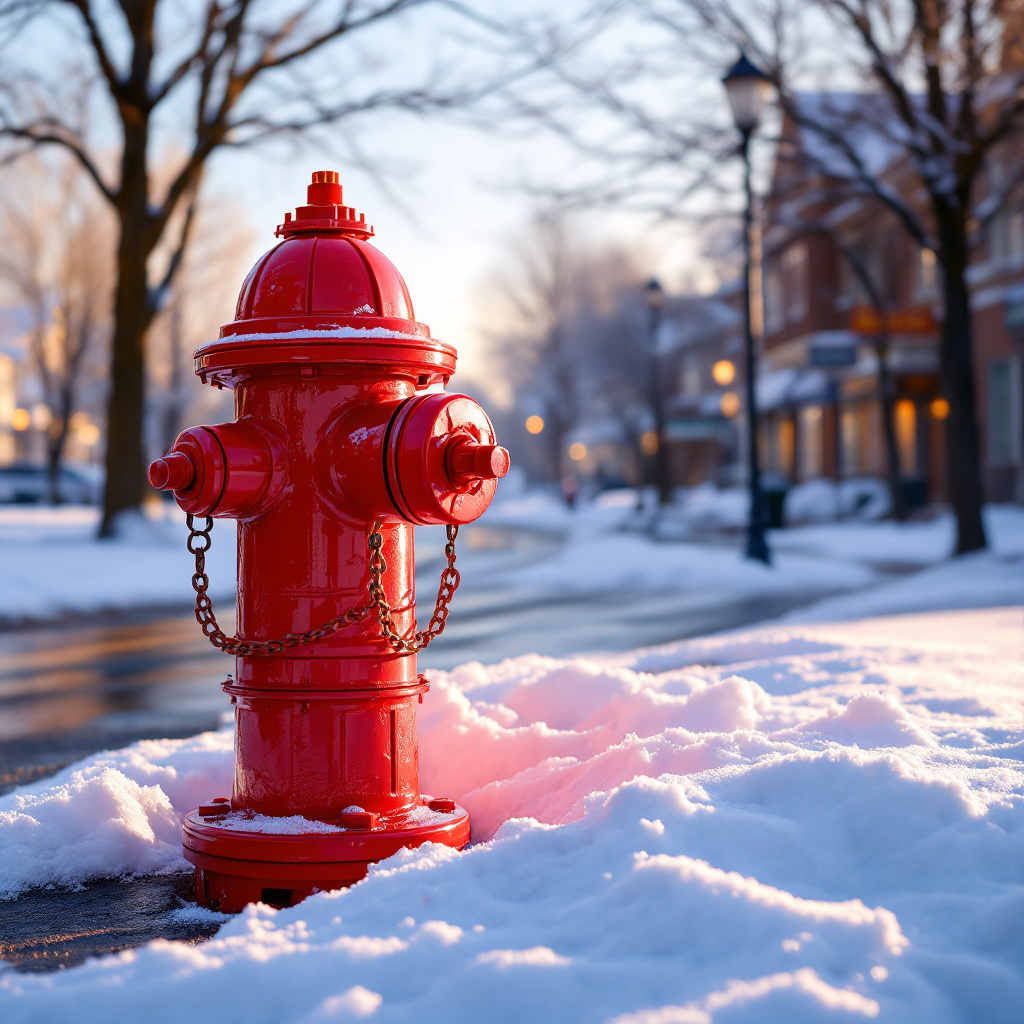
The Peace Region doesn’t forgive a hydrant that was ignored in the fall. Most hydrants in cold climates are the dry-barrel type: the main valve sits below the frost line, and the barrel above it is meant to be empty when the hydrant isn’t in use. A small drain valve at the base lets residual water seep out into the surrounding gravel after each shutoff.
When that drain fails, the barrel holds water. Water freezes. A frozen barrel can crack, or at the very least it will block flow when a crew needs it most. Here are the common ways it goes wrong:
- Plugged drain ports. Silt, clay, or a high water table in spring and fall packs the drain gravel and the port stops draining.
- Leaking main valve. Water creeps past the seat, fills the barrel slowly, and freezes. This one is easy to miss in summer because the hydrant looks fine.
- Groundwater backing into the barrel. Where the water table sits high, a sound drain valve can’t empty a barrel that’s sitting in saturated soil.
- Ice in the outlets. Condensation or meltwater freezes inside caps and threads, so the caps won’t come off in a hurry.
What does this mean for scheduling? Do your main inspection and maintenance before freeze-up, not after. Test drainage while there’s still time to fix it. A hydrant that’s checked in September and found sluggish can be repaired in October. One that’s checked in January might have to wait for a thaw.
Winter brings its own job too: clearance. A hydrant buried in plowed snow is a hydrant a crew has to dig out while a building burns. Agree with your snow-removal contractor, in writing, that hydrants are cleared and the access path stays open.
Warning signs you shouldn’t wait on
Plenty of hydrant problems announce themselves if you look. Walk your site and watch for these:
- Water pooling or staining at the base, or ground that stays soft in dry weather
- Wet or icy outlets when nobody has used the hydrant
- A bonnet or barrel leaning at an angle, usually from a vehicle strike
- Caps that are stuck, missing, cross-threaded, or cracked
- Paint peeling to bare metal, with rust blooming at the base flange
- A hydrant you can’t see from the road or driveway because of landscaping or stored material
- No record of the last time anyone operated it
Any one of these deserves a call. Two or more together should move the hydrant to the front of the line. And if your answer to the last item is “nobody knows,” you’ve found your starting point.
Repair or replace: how to think about it
Owners often assume a damaged hydrant means a full replacement. Usually it doesn’t. Hydrants are built to be serviced from the top: internal parts can often be pulled and replaced without digging up the line. A vehicle strike may be repaired with a new upper barrel section and breakaway components if the lower assembly is sound.
Replacement starts to make sense when:
- Parts are no longer available for an old model, and the hydrant can’t be kept running.
- The body is cracked or corroded past what a repair can address.
- Repeated failures have cost more than a new unit would.
- The hydrant is in the wrong place, for example blocked by an expansion or too far from the building it protects.
The manufacturer matters here. Parts, operating-nut sizes, and outlet configurations differ between models, so identifying what’s installed is the first step in any repair estimate. FourPoint keeps a manufacturer library and reference material available for exactly this reason, and the identification service helps when the nameplate has been painted over or worn away.

Hydrants don’t work alone
A private hydrant is one piece of a larger water-based fire-protection system, and the pieces share infrastructure. The same underground service line that feeds a yard hydrant often feeds a building’s sprinkler system or standpipe. That has a few practical consequences.
Scheduling. Taking a hydrant out of service, or flushing a line, can affect the rest of the system. It makes sense to coordinate hydrant work with sprinkler inspections so impairments are planned once rather than three times.
Backflow. Where the private fire line connects to the public water supply, backflow testing and cross-connection control protect drinking water from contamination. The assemblies involved need their own testing on their own schedule, and bundling those visits saves you coordination time.
Records. One provider keeping hydrant, sprinkler, standpipe, and backflow records in one place makes insurer and inspector requests a five-minute task instead of a week-long scramble.
You can see the full range on the services page.
Building a simple annual plan
You don’t need a complicated program. A workable plan for most commercial and industrial sites looks like this:
- Spring: Walk the site after thaw. Look for frost damage, heaved bases, and ground erosion around hydrants. Book repairs while the ground is workable.
- Summer: Schedule the main inspection and maintenance visit. Operate every valve, flush as needed, and record results.
- Early fall: Confirm drainage on every hydrant. Finish outstanding repairs. Brief your snow-removal contractor on hydrant locations and clearance.
- Winter: Do quick visual checks after major storms. Watch for buried or struck hydrants, and report damage immediately.
- Any time: Update your hydrant list when you add buildings, move fences, regrade, or change tenants.
That’s four touchpoints a year, and only one of them needs a technician for most properties. The rest is a facility manager with a boot-level walkaround and a habit.
Choosing a provider: questions worth asking
Hydrant work looks simple from the outside, so quality varies. Before you sign anything, ask:
- Do you inspect and repair, or only inspect? Handing off between two companies slows everything down.
- What does your report include for each hydrant? You want an individual result, not a single pass-or-fail note for the site.
- Do you serve my location regularly? Travel time affects how fast you get a repair visit. FourPoint covers Grande Prairie, Dawson Creek, and the wider Peace Region, which you can confirm on the service areas page.
- Can you handle related systems, such as sprinklers, backflow, and standpipes, if I need them later?
- Can I see examples of similar work? The project portfolio and customer reviews are a good place to start checking.
A provider that answers these without hedging is one that has done the work before.
The practical next step
If you’re not sure what you have, start with the simplest move: ask for an inspection or a quote. A first visit will tell you how many hydrants are on the site, who owns them, what shape they’re in, and what, if anything, needs fixing before winter. You don’t need a perfect site plan or a full list of hydrants to ask. Give a rough address and a description of the property, and the rest gets sorted out on the visit.
FourPoint Fire & Water takes enquiries through the website’s online form and by phone, and the office reviews every request. For more background on hydrants, regional planning, and fire-protection references, the Fire & Water Insights section is worth bookmarking. And if you’d like to know who’s behind the work, the about page covers that.
A hydrant that’s been inspected, exercised, and drained is a quiet piece of equipment. That’s the goal: one you don’t think about until the day it matters.
FourPoint Fire & Water offers inspection, maintenance, repair, installation, replacement, excavation, frozen hydrant assessment, identification, troubleshooting, and underground repairs.
06 / FAQ / COMMON QUESTIONS
Can FourPoint work on a municipal hydrant?
Ownership and authorization must be established first. A private service enquiry is not permission to operate or alter a utility asset.
Does every County property use the same water system?
Do not assume that from a regional map. Confirm the supplier and connection for the particular property with the owner and responsible utility.
Can a quote include underground repairs?
Describe the suspected location and records available. For a hydrant repair or underground enquiry, provide the legal or civic description privately to the contractor and identify the utility named on the account.