ASSEMBLY TESTING & RECORDS

Backflow prevention testing

A meaningful backflow test identifies the assembly, records the applicable test result and defines what happens if it fails. Begin with the site’s water authority, existing records and required tester qualifications.

Grande Prairie · Dawson Creek · Peace Region

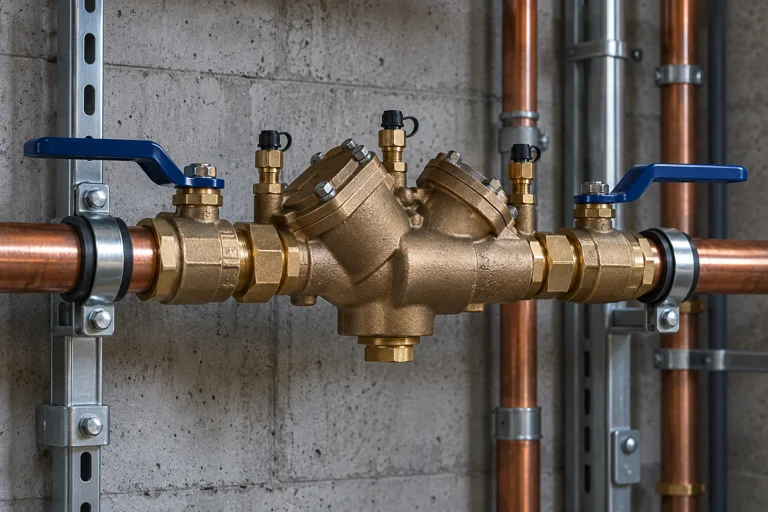
Illustrative bronze water-service assembly with blue-handled valves
AI-generated illustrative imagery. Not a FourPoint project, manufacturer product reference or installation detail.

TECHNICAL SCOPE / WITH CONTEXT

Plan the work.
Understand the record.

01

Know the assembly and its purpose.

Backflow prevention assemblies are selected for particular applications and hazards. Reduced-pressure and double-check arrangements are not interchangeable simply because they fit the same pipe. Record the manufacturer, model, size, serial number and service location before arranging testing or maintenance.

02

Testing evaluates a defined assembly.

An authorized tester applies the appropriate procedure with suitable test equipment and records the result. A visual check alone does not establish the performance of a testable assembly. Confirm access, service interruption, required qualifications and the report recipient before the visit.

03

Failures need diagnosis and follow-up.

A failed result, damaged equipment or reported discharge calls for model-specific assessment. Fouling, component deterioration and installation or pressure conditions may require different responses. Do not treat every discharge as a failed part or bypass protection to stop a symptom. Use the applicable manufacturer instructions and authorized repair process.

04

Maintenance and retesting remain distinct.

Agree the corrective work and any interruption before repair. Record parts and work performed, then arrange the applicable post-work testing and reporting. A repair receipt does not replace a required test record, and a test result does not prove that protection was correctly selected for every site hazard.

05

Owner responsibilities and local requirements.

Provide asset details and previous reports, arrange safe access and coordinate the service affected. Confirm the required schedule, accepted tester and submission process with the actual purveyor. Aquatera’s program describes annual and certain event-driven testing for affected premises; do not apply that statement automatically to another utility. FourPoint’s approved-tester status is not asserted, and any required credentials must be confirmed before work.

VALUE TO YOUR SITE

Clarity you can
carry forward.

01

An assembly-specific record that can be carried forward

02

Clear distinction between failed testing and corrective work

03

Defined reporting and follow-up responsibilities

FREQUENTLY ASKED QUESTIONS

Before work begins.

Can testing be arranged without interrupting service?

The assembly, procedure and site arrangement determine the impact. Confirm the expected interruption and any coordination needed for fire-protection or process services.

Does a passing test certify the entire property?

No. It records the assembly’s test result within the procedure and scope. Hazard assessment, installation acceptance and other property requirements are separate.

What if the assembly fails?

Record the result, notify the responsible party and agree the authorized corrective work, retesting and required reporting. Do not imply a failed assembly has passed after an undocumented adjustment.
START WITH THE SITE

A defined scope.
A useful next step.

Share your location, system information and the work you need to discuss.

Request a service quote

Local planning context.

Use the regional guides to prepare ownership, utility coordination and reporting questions. Contact FourPoint to confirm availability for the actual property.