A leaking backflow preventer should be treated as a possible failure of the device’s protective function, not as a nuisance drip. Isolate the line if it is safe to do so, keep the area clear, and have the assembly inspected and field-tested by a certified tester before it returns to service. At FourPoint Fire & Water, backflow prevention testing is one of the services we provide to commercial, industrial and municipal properties in the Peace Region and across the provinces we serve, and the guidance below is written for the people responsible for those assemblies: property managers, business owners, facility operators and municipal staff.
TL;DR
- Water that sprays, streams or runs continuously from a backflow device is a warning sign, and the assembly should be taken out of service until it has been tested.
- Most leaks trace to fouled or worn internal parts, debris, a damaged housing, or freeze damage. The cause cannot be confirmed by looking at the outside of the device.
- Repairs should follow the manufacturer’s specifications, and the device should be retested immediately after any cleaning, repair or service.
- Canadian municipalities and provinces generally require annual testing by a certified tester and a written record. Confirm your own authority’s rules.
- Keep the test reports. They are the proof that the device protected the water supply when it counted.
Table of Contents
- What a backflow preventer does, and why a leak matters
- Where the water is coming from
- Common causes of a leaking backflow preventer
- What to do when the device is leaking or spraying
- When discharge is part of normal operation
- Why a test comes before a repair
- Replacement versus repair
- Testing, access and records: the part that protects you
- A maintenance routine that reduces leaks
- Where FourPoint fits
- FAQ
- Sources
What a backflow preventer does, and why a leak matters
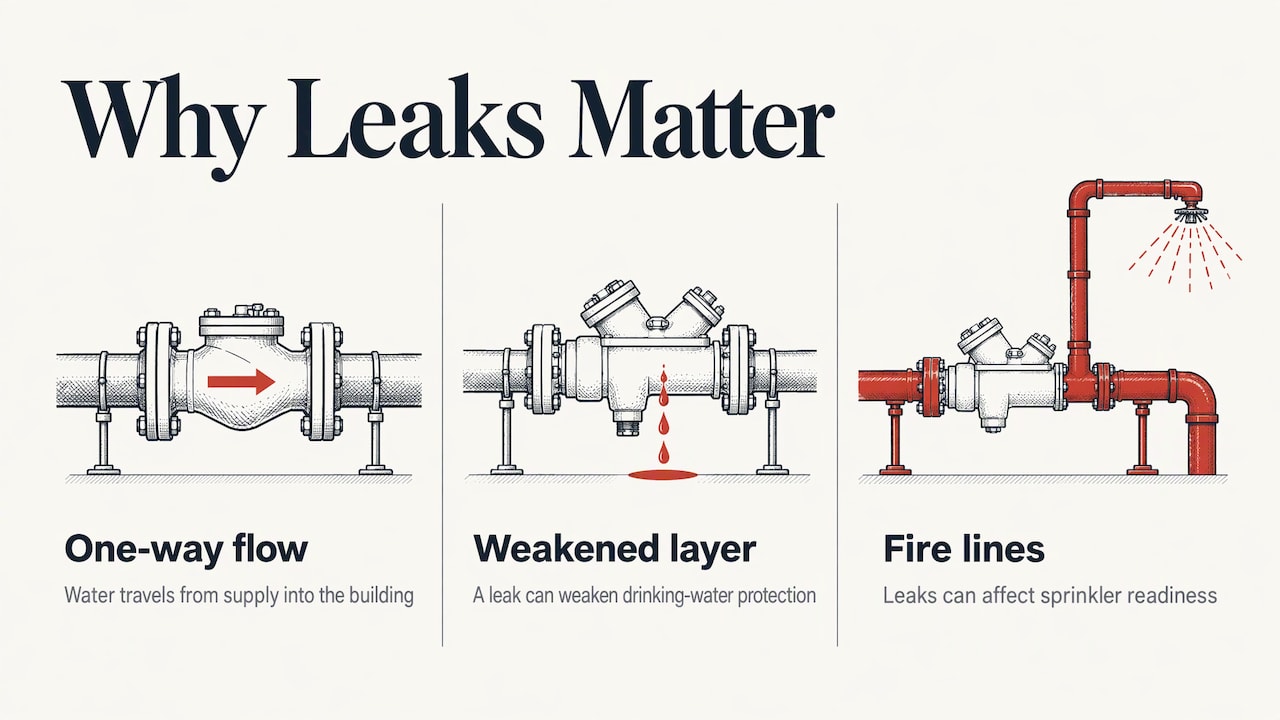
A backflow preventer is a mechanical device installed on a water line so that water can only travel in one direction: from the municipal supply into your building or irrigation, fire protection or process system. If pressure drops in the main, or pressure rises downstream, the device stops contaminated water from being drawn or pushed back into the potable supply. The Canadian Food Inspection Agency notes that federal, provincial or municipal plumbing codes require backflow prevention for potable water systems.
This is why a leak is more than lost water. The device is built from springs, rubber seats, check modules and, in some designs, a relief valve that discharges on purpose when something is wrong. A discharge, a weep or a spray can mean that one of those protective components is no longer sealing. The Region of Durham describes backflow prevention as one layer in a multi-barrier approach to safe drinking water, and a leaking assembly is a weakened layer.
For properties with fire protection, the same logic applies to the supply lines feeding sprinkler and standpipe systems, where double-check or reduced pressure assemblies often sit on the service entry. A leak there can also point to a problem that affects fire protection readiness, which is why backflow and fire systems are usefully looked at together.
Where the water is coming from
The location of the discharge tells a technician a great deal. Before anyone touches the assembly, note the following and, where it is safe, photograph it:
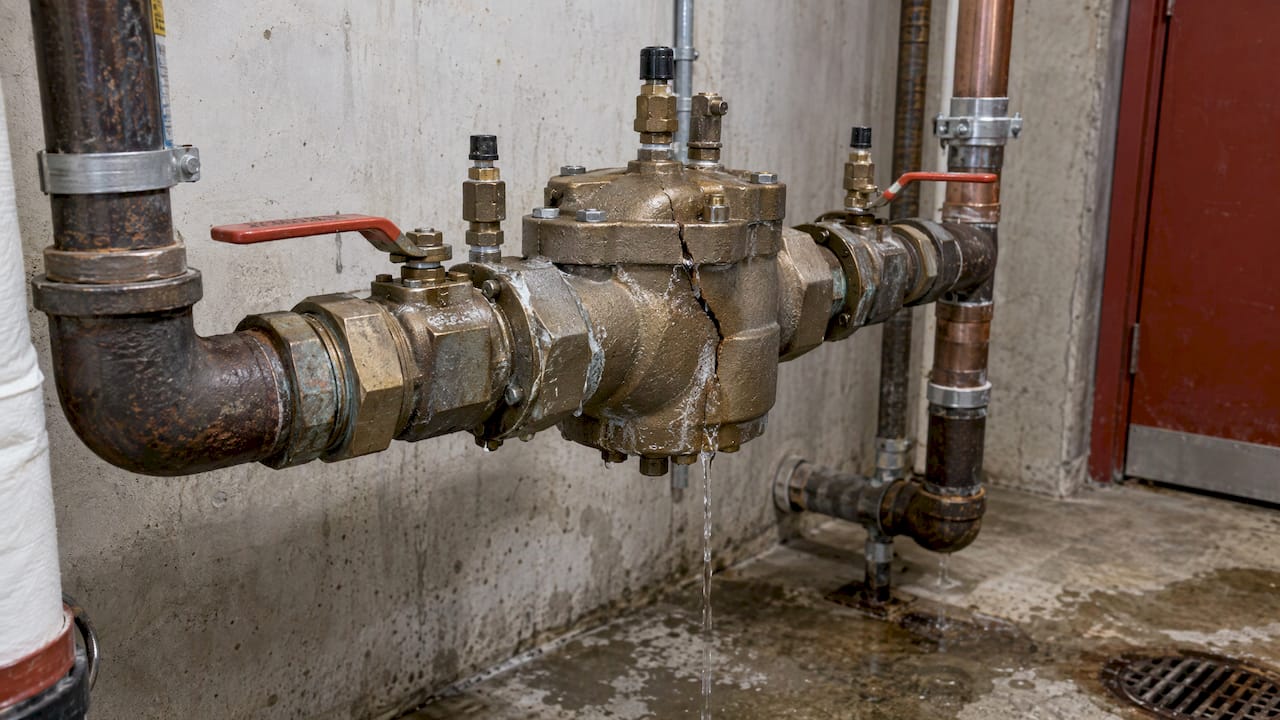
- Which part of the device is discharging. Water from the relief valve port, from the body, from a test cock, from a union or from the bonnet or cover each point to different causes.
- Whether the leak is constant, intermittent or only at certain times. Intermittent discharge often follows pressure swings in the supply or in the building.
- Whether it started after a event. A recent test, repair, water main work, a pressure surge, a cold snap or a shutdown and restart are all relevant.
- The make, model, size and type of the assembly, from the data plate. This is needed to match manufacturer repair parts.
These observations make the service call shorter and the diagnosis more reliable.
Common causes of a leaking backflow preventer
The following are the usual reasons an assembly leaks. A certified tester confirms which one applies by testing the device, because several causes look identical from the outside.
Fouled or worn seats and seals
Rubber seats, discs and O-rings wear with age and with repeated cycling. Mineral deposits and sediment can hold a seat slightly open. The result is often discharge from the relief port on a reduced pressure assembly, or a slow passing of water through a check. The CFIA’s guidance calls for mechanical backflow preventers to be visually inspected for fouling, wear or fatigue, checked to confirm they have not been bypassed, and tested to confirm they function properly. Fouling and wear are exactly the conditions that produce leaks.
Debris in the line
Construction, main repairs and new piping release sediment, scale and fragments. A small particle lodged on a check seat can stop it from sealing. This is common after commissioning, after work on the water main, and after a long shutdown.
Pressure fluctuations
Supply pressure that rises and falls, or thermal expansion in a closed system downstream, can push a device into a discharge cycle. In such cases the device may be reacting to a system condition rather than failing by itself, but only testing can distinguish the two, and the underlying pressure condition still needs to be corrected.
Freeze damage
In Alberta, northern British Columbia, Saskatchewan and Manitoba, winter is a leading cause of cracked bodies, split covers and damaged test cocks. Damage often appears as a leak only after thaw or when the system is pressurized again. A cracked housing cannot be repaired with new internal parts, and the assembly generally needs to be replaced.
Damaged or incorrectly installed components
Over-tightened or mismatched parts, a replacement part that is not the manufacturer’s, or an installation that does not follow the standard can all cause leaks. The City of Surrey’s cross connection requirements state that repairs must conform to the manufacturer’s specifications and that internal parts replaced must be the manufacturer’s approved new replacement part. Substituting generic parts is therefore a compliance problem as well as a performance one.
Age
Mechanical assemblies do not have a single universal service life. How long one lasts depends on water quality, pressure conditions, how often it cycles, freeze exposure and how consistently it has been serviced. Annual test records are the most reliable way to see an assembly’s condition changing over time.
What to do when the device is leaking or spraying
The aim is to limit water damage and keep the potable supply protected, without improvising on a device that is a regulated safety component.
- Keep people clear and watch for hazards. Spraying water near electrical equipment, in a mechanical room or on a walkway in freezing weather is a slip, electrical and property-damage risk.
- Isolate the water to the assembly if you can do it safely. Closing the upstream shutoff stops the discharge. Know in advance where the isolation valves are. If the device serves a fire sprinkler or standpipe supply, closing the valve impairs fire protection, so notify the building’s fire safety lead and follow your impairment procedure, and get the line back in service quickly.
- Record what you see. Note the location of the leak, the time, and the conditions, as described above.
- Do not bypass or remove the device. Removing an assembly while the cross connection still exists leaves the supply unprotected. The City of Surrey requires that a backflow preventer not be removed while the cross connection remains a threat unless a replacement is installed, and it requires a verification form to be filed when one is removed.
- Arrange a test by a certified tester. The CFIA recommends that a qualified person test backflow preventers, and notes that provincial water associations or municipalities may provide lists of certified testers.
- Notify your water authority if your by-law requires it. Some municipalities require written confirmation of a failure within a set time. Under the City of Owen Sound’s by-law, a device that fails a retest must be taken out of service immediately and replaced or the water service shut off, with written confirmation of the failure provided to the City Engineer within forty-eight hours. Other authorities set their own timelines, so confirm the rule that applies to your property.
When discharge is part of normal operation
Some assemblies are designed to discharge. A reduced pressure assembly has a relief valve that opens when the pressure differential across the device falls below its design threshold, and a short discharge on that valve can happen during certain pressure events. A continuous or repeated discharge, or any spray from the body or a test cock, is not normal. Because a property manager cannot tell by sight whether a discharge is within design or a sign of a fouled check, the practical rule is to treat any recurring or continuous discharge as a reason for a test.
A second distinction matters: a leak at a union or a test cock is a different kind of fault from a discharge at the relief port. The first is usually a sealing or fitting issue, the second usually means the checks are not holding. Both are resolved by a technician testing the device with calibrated equipment, not by tightening fittings.
Why a test comes before a repair
A technician who tests first learns which component is not sealing, which avoids replacing parts that were fine and avoids returning a device to service with a hidden fault. The City of Surrey’s standards set out that the minimum field test performance requirements should be determined in CAN/CSA-B64.10.1 or the current BCWWA testing procedures, and that the certified tester must have the tools and equipment needed to access, identify, field test and troubleshoot the device in a safe and professional manner.
The national standard has been updated. CSA B64.10:23 and CSA B64.10.1:23, published June 30, 2023, set out requirements for selection and installation, with maintenance and field-testing requirements in B64.10.1, and supersede the 2017 editions. Your authority may reference a specific edition, so ask which one it applies.
A proper sequence looks like this:
- Identify the assembly type, size and location, and confirm it is the right device for the hazard.
- Perform a field test with calibrated test equipment to find which checks or relief components are failing.
- Clean or repair using the manufacturer’s approved parts and procedures.
- Retest and document the passing result.
- Submit the report to the authority if required, and file a copy.
The retest is not optional. The City of Owen Sound’s by-law requires testing at first installation and annually, and also immediately after the device is cleaned, repaired, overhauled, serviced, relocated or inactive for 90 days or longer.
Replacement versus repair
A leak does not always mean replacement. Worn seats, fouled checks and damaged springs are typically restored with manufacturer repair parts. Replacement becomes the answer when the housing is cracked, usually from freezing, when the body is corroded, or when the model no longer has available parts. Replacement is also the correct response where the device does not meet current requirements for the hazard. The Régie du bâtiment du Québec notes that a single check valve does not provide effective protection; only devices approved to CSA B64 and installed to CSA B64.10 give that level of protection. If a leaking assembly turns out to be an unsuitable type, replacing it with a properly rated device resolves both issues at once.
When an assembly is replaced, the new device is installed to the current standard, tested at installation, and added to your annual testing schedule.
Testing, access and records: the part that protects you
Leaks are easiest to deal with when they are found at a scheduled test rather than during an event. Across Canada the rules are similar in principle, though they differ in detail by authority:
| Authority | What it requires |
|---|---|
| City of Owen Sound (Ontario) | Test at installation and annually, and after cleaning, repair, relocation or 90 days of inactivity (by-law 2022-003) |
| City of St. John’s (Newfoundland and Labrador) | Premises isolation device kept in operation and tested at least annually to CSA B64.10.1 by a certified tester; supply may cease if certification is not provided (policy 08-04-18) |
| Region of Durham (Ontario) | Premise isolation device installed, tested and maintained annually; cross connection survey every five years (by-law 24-2018) |
| Québec | Verification at installation and annually by a certified inspector, with records kept (Régie du bâtiment du Québec) |
These examples show the pattern rather than the rules for your property. Your own municipality or water purveyor sets the requirement that applies to you, and the plumbing code adopted in your province sets the baseline.
Two practical points follow from them. First, keep the assembly accessible. The City of St. John’s policy requires the device to be kept accessible in a non-confined area so it can be inspected or tested at any time, and an assembly boxed in, buried or blocked cannot be tested or serviced properly. Second, keep the records. A file with each year’s test report, repair invoice and retest result is the evidence that the device has been maintained, and in some jurisdictions it is a legal obligation.
A maintenance routine that reduces leaks
The following routine suits property managers, facility operators and municipal staff alike:
- Inventory every assembly, with location, type, size, serial number and the hazard it protects against.
- Schedule annual testing with a certified tester, ahead of the season when the device is most needed (irrigation startup in spring, for example).
- Winterize exposed assemblies where freezing is possible, and inspect them for cracks at spring startup.
- Check visually between tests. Look for staining, mineral build-up, corrosion, drips and anything stored against the device.
- Keep clearance and drainage. The relief port must be able to discharge to a safe location without flooding equipment.
- File every report and track due dates for retests after any service.
- Review the cross-connection picture when the building’s use changes, because a new process or tenant can change the hazard level.
The owner checklists on our site can be used to build this inventory and routine, and our standards and scope page explains how fire protection requirements fit together.
Where FourPoint fits
The work is led by a Red Seal Journeyman Sprinkler Fitter with over two decades of experience in commercial and industrial environments. Our process is built around a site-specific assessment and clear communication, so that scope, context and equipment details are settled before any work is arranged.
For a leaking assembly, the practical starting point is our backflow prevention testing service, which gives you a documented result and a clear picture of the device’s condition. Where the assembly is part of a wider cross-connection control program, our cross-connection control service covers that scope, and where the leak sits in a sprinkler supply, our sprinkler repairs page describes the related work. We serve Grande Prairie, Dawson Creek and the wider Peace Region.
If you manage assemblies across several properties, send us the list and the location of the leaking device. A scoped assessment first means you know what is being tested and why before any work is arranged. You can start from the backflow testing page.
FAQ
Is a leaking backflow preventer an emergency?
It should be treated as urgent. Spraying or continuous discharge can cause property damage and may mean the device is no longer protecting the water supply. Isolate the line if it is safe to do so, and arrange a test by a certified tester as soon as possible.
Can a backflow preventer leak and still be working?
Some reduced pressure assemblies discharge briefly through the relief valve by design. Any continuous, repeated or body-level leak is a reason to test, because the cause cannot be judged by sight. A field test with calibrated equipment is the only reliable way to tell.
How often should a backflow preventer be tested?
Most Canadian authorities that publish a rule require testing at installation and at least annually, and again after repair, cleaning or relocation. For example, Durham Region requires annual testing of premise isolation devices. Confirm the requirement of your own municipality or water purveyor.
What happens if the device fails its test?
It must be repaired or replaced and retested before it returns to service, and some authorities require written notice of the failure within a short period. In Owen Sound, for example, that notice is due within forty-eight hours of the retest. Keep the failed and passing reports on file.
Who can test a backflow preventer?
A certified tester. The CFIA advises that provincial water associations or municipalities may keep lists of certified testers. In the Peace Region, you can book that testing with us through our backflow testing page.
Sources
- Preventing water backflow, Canadian Food Inspection Agency
- Cross Connection Standards and Specifications, City of Surrey
- Backflow Prevention By-law 2022-003, City of Owen Sound
- Backflow Prevention Program, Region of Durham
- Premises Isolation policy 08-04-18, City of St. John’s
- Watch out for contamination, Régie du bâtiment du Québec
- CSA B64.10:23 and B64.10.1:23, Standards Council of Canada